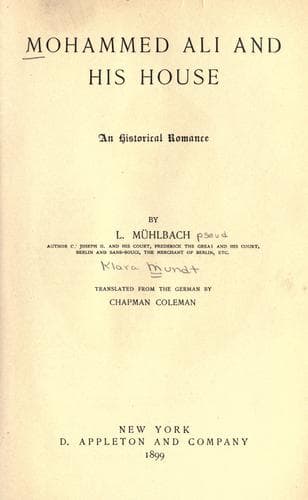
Egypt -- History -- Mohammed Ali, 1805-1849 -- Fiction; Muhammad Ali Basha, Governor of Egypt, 1769-1849 -- Fiction
All was still; nothing could be heard but the murmur of the sea, and
the rustling of the wind.
The merchant, who had at first stood in silence beside the two, now
walked noiselessly away.
They love each other, and what they have to say, no one else should
hear.
Mohammed stands up and dries his eyes; he wishes to be composed.
Osman holds out his hand:
"Your mother is dead, but she survives in your friends, and your
mother and your friend now extend the hand to you. Mohammed, come
with me to my house, for my house is yours, too. I will not have you
remain alone; you must come with me."
Mohammed shook his head gravely. "It cannot be--I will not become a
slave!"
"Come, out of love for me. Not as my slave, but as my friend. Oh, I
am so lonely, and you are the only one who loves, and can console,
poor, sickly Osman."
"I will come to you!" exclaimed Mohammed, drawing his friend to his
bosom. "Even as a slave would I come, for I should be my friend's
slave. I will come to you."
CHAPTER X
COUSROUF PACHA.
THE days had passed quietly and monotonously for Mohammed since the
death of his mother.
To climb among the rocks with his gun in stormy weather, to cross
over in his boat to Imbra, after the fishermen's nets and fish, and
to tame the young Arabian steeds of the tschorbadji that had as yet
known no bridle, these were now Mohammed's chief pursuits and
pleasures, and in them he engaged with passionate ardor when at
leisure, that is, when not with his friend Osman Bey.
That which they had vowed to each other after the death of
Mohammed's mother, they had kept-true and firm friendship, brotherly
and confidential intercourse. With one wish only of young Osman, had
Mohammed not complied: he had not gone to live with him in the
proud, governmental building-had refused to share his friend's
luxury and magnificence, and to allow his poverty to be put to shame
by the benefits which he would have been compelled to accept.
The hut, inherited from his parents, he retained as his own
dwelling. In it nothing had been changed; the mat on which his
mother had died was now his bed. In the pitcher out of which she had
drunk, he each morning brought fresh water from the spring, and all
the articles she had used, poor and miserable as they were, now
constituted the furniture of his hut.
In vain had Osman continually renewed his entreaties: "Come to me.
Live with me; not for your own sake, Mohammed. I know that you
despise luxury, and that the splendor that surrounds us is offensive
to you. Not for your own, but for my sake, Mohammed, come to me and
live with us. My father is so anxious to have you do so, for he
knows that your presence is the best medicine for me. I feel so well
and strong when I look at you, Mohammed; and, when you sometimes
yield to my entreaties and spend the night with me in my room, it
seems to me I sleep better, for I know that my friend is watching
over me. Stay with me, Mohammed!"
Public-domain text, read in full here on John Shaqi.
Reviews
Reviews
No reviews yet
Be the first to share your thoughts on this work.
Elsewhere in the archive
Join the Discussion
Join the discussion
Sign in to leave a comment or review.
Sign InorCreate an account