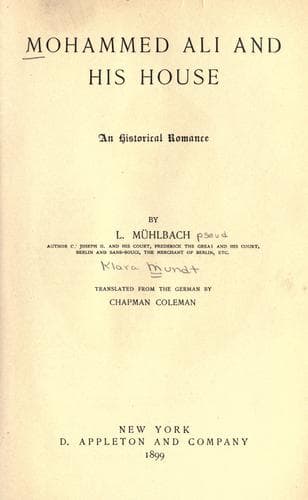
Egypt -- History -- Mohammed Ali, 1805-1849 -- Fiction; Muhammad Ali Basha, Governor of Egypt, 1769-1849 -- Fiction
These soft entreaties, accompanied by tender looks, touched
Mohammed, but they could not shake his resolution.
"I cannot and dare not accept, Osman. It would make me unhappy; I
should feel myself under too much restraint; I must, above all,
preserve the consciousness of being perfectly free and independent.
I must feel that I can leave when I choose, and for this very reason
is it so sweet to remain--to be with you, unfettered for your sake
only, Osman. If I should come and live with you in the palace of the
tschorbadji, do you not think I should be an object of dislike to
your slaves and servants; that they would point at me when I passed,
and whisper: 'How proud and insolent he is, and yet he is less than
I! We are the slaves of our master, and repay with our work the
money he spends on our account. But what is he? A proud beggar
supported by charity, who has the impudence to give himself the airs
of a gentleman.' Your slaves would say this of me, and mock me with
my beggar pride. But, as it is, I am free, and my clothing is my
own. It is certainly not as handsome as yours, the caftan not
embroidered, the shawl not of Persian make, and the kuffei around my
fez not inworked with gold. But yet it is my own, and it pleases me
to be thus plainly dressed, as it becomes the son of Ibrahim Aga. I
live as it becomes me; my hut is dark and poor--but it is mine, and
in it I am a free man. I do not sleep on soft cushions; a plain mat
is my bed, but on this mat my mother reposed, and on it she died. To
me it is sacred. I pray to my mother each night, Osman, and I greet
her each morning when I drink out of the wooden cup so often touched
by her lips. I should have to give up all this, and come here to
repose in splendid apartments, sleep on silken mattresses, and allow
myself to be waited on by slaves who do not belong to me. No, Osman,
do not demand this; let me come to you each day, of my own free-will
and love."
He extended his hand to his friend, who, as usual, lay reclining on
his couch, and Osman pressed it warmly in his own.
"You are a proud boy," said he, in low tones, "and though your
refusal gives me pain, I can still understand that in your sense you
are right, Mohammed. In short, you do not wish to be grateful to
anybody."
"And yet I am grateful to you, Osman," said Mohammed, regarding him
tenderly; "all my heart is full of gratitude and love for you; but
how much do I owe to you! Is it not for your sake that your father,
the proud tschorbadji, is so kind and friendly to me? Does he not
allow me, the lowly born, to sit with him at his table, and treat me
as his equal?"
Public-domain text, read in full here on John Shaqi.
Reviews
Reviews
No reviews yet
Be the first to share your thoughts on this work.
Elsewhere in the archive
Join the Discussion
Join the discussion
Sign in to leave a comment or review.
Sign InorCreate an account