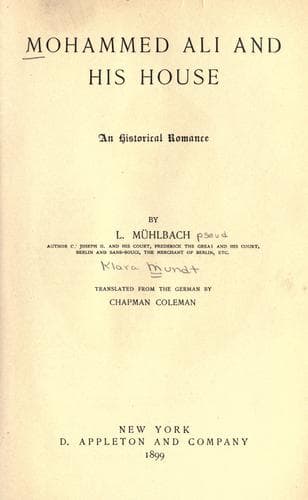
Egypt -- History -- Mohammed Ali, 1805-1849 -- Fiction; Muhammad Ali Basha, Governor of Egypt, 1769-1849 -- Fiction
"Consider that Osman is my only child, and my only happiness.
Consider that he loves Mohammed as if he were a brother. The
physicians say he would die if separated from Mohammed. Be merciful,
and forgive the insolence provoked by your own overbearing words. I
entreat you to be merciful, and to come away with me."
He took Cousrouf's arm in his own, and drew him away, almost
forcibly entreating him, with all the anxiety of a father's heart,
to forgive the uncultured youth, who knew nothing of becoming
deportment and polished manners. He was an untamed lion, unfamiliar
with the gentle ways of the domestic animals.
"And yet I wish I had this young lion in my power," said Cousrouf,
gnashing his teeth with rage, as he followed the governor. "I should
extract his teeth, and prove to the monster that he was not a lion,
but only a miserable cat, to be trodden under my feet!"
The tschorbadji drew him away more rapidly, that Mohammed might not
hear him. He had looked back and perceived that Mohammed was
standing still, gazing at them with a threatening eye, and, in
reality with the bearing of a lion prepared for the deadly spring.
When they had disappeared, Osman rose from his cushions, stood up,
threw his arms around his friend's neck, and kissed his quivering
lips.
"I thank you, my hero, my king, my lion! You stood there like David
before Goliath, and overthrew him in the dust. You made the insolent
giant small, you hero. I thank you, my Mohammed!"
CHAPTER XI
THE REVOLT.
The great square which lay in the centre of the village of Praousta
resounded with wild outcries and clamorings. All the men of the
place had assembled by the sea shore; they were generally honest,
peaceful sailors, but today they were raging rebels roused to revolt
against those in authority, and refusing obedience to the
tschorbadji.
Two pale, trembling men stood in the midst of the revolting crowd.
They were evidently Turks, by their closely-fitting uniforms, and
the scarlet fez on their heads; the short arms which hung at their
sides showed them to be the kavassen, or the collectors of the
tschorbadji.
These collectors were always an abomination to the people of
Praousta; they greeted them constantly with murmuring when they came
to collect the taxes, and often, before now, the appeasing,
tranquillizing words of the sheik had alone secured the payment of
the sums demanded. Today, however, their long-restrained indignation
had broken forth. Today, although the sea was so still and peaceful,
no one had gone out to fish, for it had been fully determined that
on this day they would refuse the demands of the governor's
collectors. The collectors had gone to the village, suspecting
nothing. The assessment had been brought by one of them several days
before to the sheik, who had received it with a very troubled
countenance.
"A double tax? " he had said; "that will be most unwelcome to the
men of Praousta."
Public-domain text, read in full here on John Shaqi.
Reviews
Reviews
No reviews yet
Be the first to share your thoughts on this work.
Elsewhere in the archive
Join the Discussion
Join the discussion
Sign in to leave a comment or review.
Sign InorCreate an account