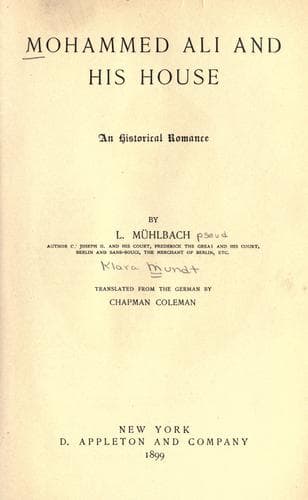
Egypt -- History -- Mohammed Ali, 1805-1849 -- Fiction; Muhammad Ali Basha, Governor of Egypt, 1769-1849 -- Fiction
"Now I turn to you," said Mohammed, breathing more freely, and
looking toward the sheik and the ulemas.
"Will you murder us?" asked the sheik Alepp, as he looked with calm
dignity at the young man.
"No, if your blood must flow, so be it upon your own head," answered
Mohammed, earnestly. "You alone shall decide your own life or death,
and that of your three companions.--Come, soldiers, open this door;
we go out this way."
The soldiers obeyed, and opened the door on that side of the mosque
which lay nearest the mountain stairway.
The sheik and the ulemas, soldiers accompanying them, passed out,
Mohammed in front of them, his drawn sword in his hand. Behind them
came the collectors, with pikes in their hands.
Silently they went on their way toward the mountain-path.
The men who had waited, uncertain what to do, before the door of the
mosque, now went round to the side, and with out-cries of rage
pointed out to one another the road to the mountain-path.
When Mohammed heard this outcry, he stood still, and motioned to the
soldiers to go forward with the prisoners. "Remain at my side,
collectors, we will cover the rear. Forward, now! go up the
mountain."
And while those went upward, Mohammed remained at the foot of the
mountain. On either side the collectors, and in front of him all the
fishermen of Praousta, more than fifty men, with threatening looks
and burning eyes. But still, although they muttered and quarrelled,
and even raised their fists, they dared not approach this young man,
whose countenance was so determined, so full of energy, whose cheeks
were so pale, and on whose mouth rested so threatening an
expression. He must have appeared to them like the angel of death,
and each one feared that if he approached he would sink down and
die.
Mohammed paid no attention to the threatening group of men. His eye
looked beyond them--there, behind the men, where the veiled white
figure stood, supported by two women.
He looked toward her, and the ringing tones of the young girl's
voice sounded in his heart, and he seemed to hear the words: "If you
have a mother you love, then think of her!"
He thought of her, and a deep sigh escaped his soul. But, still, he
must be a man now. He had sworn to bring the rebels of Praousta back
to obedience. He must keep his word, and he will do it. "If she has
swooned away, she will awake and forget her grief. Women are readily
grieved, but their grief is easily dissipated. She will know how to
console herself; and as for me, I will forget her, I will never give
her another thought."
He said this defiantly to himself, and looked again at the men of
Praousta, who were still standing irresolute and murmuring near the
mosque, not daring to approach the three armed men. "He certainly
would not have come alone, he would not dare to remain standing
there, if his comrades were not concealed somewhere up there in the
mountain."
Public-domain text, read in full here on John Shaqi.
Reviews
Reviews
No reviews yet
Be the first to share your thoughts on this work.
Elsewhere in the archive
Join the Discussion
Join the discussion
Sign in to leave a comment or review.
Sign InorCreate an account