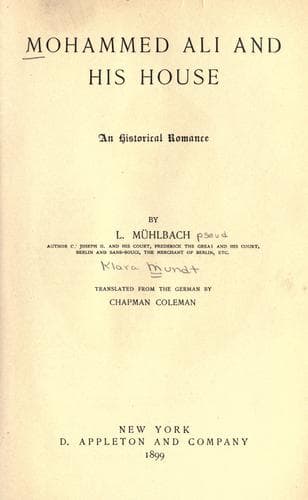
Egypt -- History -- Mohammed Ali, 1805-1849 -- Fiction; Muhammad Ali Basha, Governor of Egypt, 1769-1849 -- Fiction
"Force conquers even the philosopher. He who feels himself in the
right is silent, and utters no complaint," so exclaimed the sheik in
a loud voice, as he was thrust inside the enclosure by the soldiers.
The ulemas bowed their heads and followed him. "Allah be praised,
and may the prophet look down in mercy upon the most insignificant
of his creatures!"
The door of their prison closed behind them; Mohammed took the key
and concealed it about his person. "Now," said he, "pray and
meditate upon your crimes and their punishment. I will myself make
known to the men of Praousta that they may find you here, and all
who wish can come to see you. It rests with you to tell the people
that they must submit to the law, or else bring your heads to the
block. Think well of this, and rest assured the tschorbadji will
confirm what he has declared through me. To-morrow, at the hour of
prayer, must the double tax be paid by the men of Praousta, or your
heads shall be placed on the cliffs where everybody can see them,
and your bodies thrown upon the rock Bucephalus, that the vultures
and ravens may feed upon them."
CHAPTER II
MASA
The sea lay like a sleeping lion reposing after a conflict, and
curled its waves dreamily upon the mountain-rock Bucephalus. The sun
was burning hot, and no breath of air cooled the atmosphere, and not
one cloud or shadow afforded protection from the glowing rays of the
sun, which fell full upon the uncovered space within which the sheik
and the ulemas had been confined since early in the morning. But
they stood firm, and no complaint escaped their lips. With their
heads turned to the east, they knelt and prayed, their whole bearing
expressing dignity and high resolve.
At the command of Mohammed, one of the governor's collectors was
sent to Praousta. He was instructed to place himself in front of the
mosque, call the people together by the sound of the tomtom, and
announce to them, in the name of the tschorbadji, that all who would
see the victims of their rebellion should come up the mountain, but
without arms, and only three at a time. They should be allowed to
enter the court-yard of the palace, where they could see that the
prisoners were still alive, and that their lives and liberty rested
solely with the men of Praousta. In conformity with this
proclamation, the men of the village came up to the palace in
threes.
Above, upon the rock, knelt a young girl, closely veiled. The men of
Praousta knew well that this was Masa, the sheik's daughter. They
bowed low before her, and greeted her with the greeting of peace.
She raised her trembling hands toward them, exclaiming: "Have pity
on my unhappy father! Submit to the law! Yield to necessity! O save
my father, and do not make me an orphan!"
Public-domain text, read in full here on John Shaqi.
Reviews
Reviews
No reviews yet
Be the first to share your thoughts on this work.
Elsewhere in the archive
Join the Discussion
Join the discussion
Sign in to leave a comment or review.
Sign InorCreate an account