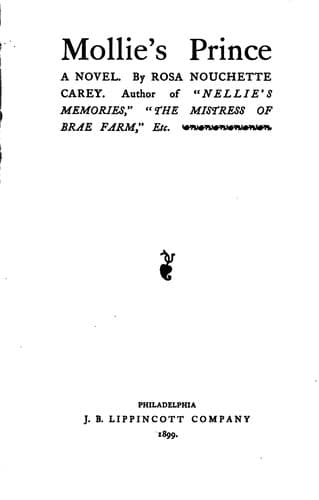
England -- Social life and customs -- 19th century -- Fiction; Love stories; Twins -- Fiction; Young women -- Fiction
Waveney would willingly have helped in the work, but Althea had other
employment for her. Some of her pensioners lived on the other side of
the river, and Waveney, who often acted as her almoner, went off early
in the afternoon to order parcels of groceries and other good things,
and to carry them to two or three old women who lived in the almshouses.
The old women were garrulous, and detained her with accounts of their
various ailments, so it was quite dark before the little gate of the
almshouse garden closed behind her. For some time she had heard the
pattering of the rain against the window-panes, and knew that she would
have a long, wet walk home.
"Aye, but it is a wild night," observed Mrs. Bates, lugubriously, as she
stirred her bright little fire afresh, "and it makes one shiver to one's
very bones, that it do."
"But your warm shawl will be a comfort," returned Waveney, cheerfully.
"Well, I must go now. 'A happy Christmas to you,' Mrs. Bates, and I hope
your rheumatism will soon be better." And then Waveney unhasped the
upper half of Widow Bates's door, and peered out into the darkness.
It was not inviting, certainly. The cold, sleety rain was falling in
torrents. A wild night, assuredly, and one that meant mischief. But
Waveney wore a stout waterproof cloak that Althea had lent to her, and
thought she would be proof against any amount of rain or sleet. True,
her umbrella was just a little slit, but she would soon have it
re-covered.
A narrow, winding passage, resembling a cathedral close, led to High
Street. A few old-fashioned houses fronted the garden wall of the
Vicarage. Here it was so dark that Waveney was rather startled when she
heard a child's voice close to her elbow.
"Oh, please, I am quite lost, and will you take me home?"
There was something familiar in the voice, but in the darkness it was
impossible to see the child's face; but Waveney's ear was never deaf to
any childish appeal.
"Oh, you poor little thing," she said, kindly, "where do you live, and
what is your name?"
"I am dad's little Betty," returned the child. She spoke in a tired,
dreary little tone, "and I live across the water, past the church, with
Uncle Theo and Aunt Joa." Then, in spite of the wet, Waveney stooped
down and put her arm round her.
"Why, it is my little friend, Betty," she said, in a puzzled tone. "Why
are you out alone this dreadful night? Oh, you poor darling, your frock
and jacket are quite soaking. Come, come, we must go home as fast as
possible. Give me your hand, dear, and come closer to me, so that my
umbrella may shelter you."
"Is it my little lady?" asked Betty, in a perplexed voice. "She did
speak to me so kindly once on the seat by the river; but I have never,
never seen her again."
"But we shall see each other presently, when we get to the shops,"
returned Waveney, cheerily. "Betty, darling, tell me, why are you out by
yourself?"
Public-domain text, read in full here on John Shaqi.
Reviews
Reviews
No reviews yet
Be the first to share your thoughts on this work.
Elsewhere in the archive
Join the Discussion
Join the discussion
Sign in to leave a comment or review.
Sign InorCreate an account