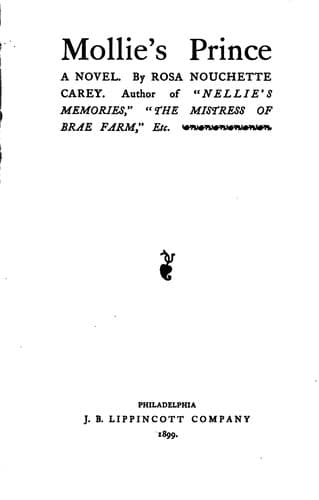
England -- Social life and customs -- 19th century -- Fiction; Love stories; Twins -- Fiction; Young women -- Fiction
"Oh, father, is Mr. Ingram here?" she whispered. "How sorry he will be
to hear I am ill!" And then a sudden thought struck her, and she
beckoned to Althea rather excitedly. "Miss Harford," she said, in her
poor, hoarse voice, "will you do something for me? In that small
right-hand drawer behind you, you will see a little parcel; it is
directed. Please give it to Mr. Ingram from me."
Althea secretly marvelled at this, but held her peace. When the dainty
white parcel was in her hand, she said, gently,--
"Yes, dear Mollie, he shall have it directly he returns. But now your
father does not wish me to stay. Good-bye. God bless you, my child." And
Althea's tone of faltering tenderness arrested Everard's attention.
"It would not be safe. I dare not let you do anything for her," he said,
very softly, as he opened the door. "I will stay with her until the
nurse comes. But please, go down and rest." And Althea, who was
trembling with some strange emotion, obeyed him without a word.
CHAPTER XXIX.
BARMECIDE'S FEAST, AND A BROWN STUDY.
"Control, give, sympathise: these three must be learnt and
practised: self-control, charity, and sympathy."
_Oriental Saying._
Althea was glad of a few minutes' quiet to recover herself, for she felt
agitated and shaken. The sight of that comfortless sick-room, and
Everard's worn face and haggard eyes, oppressed and saddened her.
A perfect passion of pity for him and his motherless girls swept over
her as she closed the door. She had left the room in answer to a
wistful, pleading look from him; her presence there evidently troubled
him, and he was unwilling for her to run any risk. It was kind, it was
friendly of him, she thought. Everard always had a good heart; but at
that moment her impulsive, highly wrought nature only yearned to show
her sympathy in action. In spite of her sensitive nerves, she was
constitutionally brave, and had no fear of any form of illness. "We
shall only die when our time comes," was a favourite saying of hers, and
neither she nor Doreen shirked anything that met them in their daily
path of duty.
Mollie was very ill, there was little doubt of that, and she would
probably be worse. The sight of the sweet, flushed face, and the
remembrance of the poor, thick voice would haunt her, she knew; and
there was Waveney----But at this point the sound of a hansom driving up
rapidly dispersed her gloomy thoughts, and the next moment Lord Ralston
entered the room.
"We have got her!" he said, triumphantly,--"Nurse Helena, the best and
cleverest nurse in the Institution; and she will be here in ten minutes.
I saw the matron, and there is another one coming at eleven to-morrow. I
shall go round to Dr. Duncan's house presently, and have a talk with
him. We must have Sir Hindley Richmond down, I am determined on that."
Public-domain text, read in full here on John Shaqi.
Reviews
Reviews
No reviews yet
Be the first to share your thoughts on this work.
Elsewhere in the archive
Join the Discussion
Join the discussion
Sign in to leave a comment or review.
Sign InorCreate an account