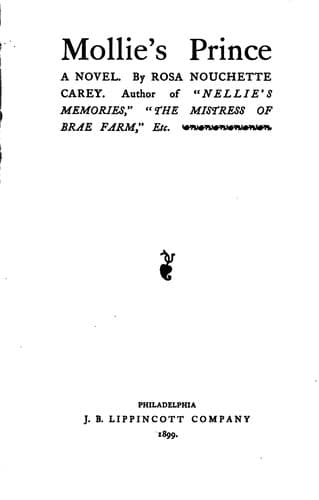
England -- Social life and customs -- 19th century -- Fiction; Love stories; Twins -- Fiction; Young women -- Fiction
"Why should you go?" returned Mollie, piteously. "I thought it would be
so nice to see you, and I wanted so to thank you. You have done so much
for me! Waveney told me that you would not like to be thanked; but
indeed, indeed, I am grateful."
"Grateful to me!" returned Ingram, indignantly, and he dropped her hand.
"Mollie, do you wish to pain me, that you say such things to me?
Gratitude! when I would willingly give you everything I possess! Unsay
those words, my darling," he pleaded, passionately. "Don't you know
that I love you better than anything in the world? Oh, Mollie,
_dearest_, if I had lost you I think I should have mourned for you all
my life."
Ingram was certainly not acting up to his theory. Monsieur Blackie had
utterly forgotten his _rôle_. He had promised himself to keep perfectly
cool and collected, to be kind and friendly, and to avoid all emotion or
excitement, but before ten minutes had passed he was pouring out his
pent-up feelings.
"Oh, Mollie, dear Mollie!" he went on, in a broken voice--for Mollie,
shaken and agitated, had hidden her face in her hands--"all this time I
have been trying to win you. I want you to be my sweet wife, to give me
the right to watch over you all my life. Darling, do you think you can
care for poor Monsieur Blackie a little?"
"I do care," sobbed Mollie. "How can I help it, when you have been so
good to me? I think"--but Mollie whispered this with her soft cheek
pressed against his shoulder as he knelt beside her--"I think I have
cared for you all this time." And perhaps that moment's ecstasy fully
repaid Moritz for all the pain of the last few weeks.
Moritz behaved very well on the whole. When the first few minutes of
beatitude were over, Mollie's pale cheeks and tearful eyes reminded him
that she was an invalid, and he forbore to overwhelm her with his
delight and gratitude. He sat beside her talking quietly, while Mollie
lay back on her pillows in languid happiness, listening to her lover. He
was telling her how proud he was of his sobriquet, and that no other
name would ever be so dear to him as "Monsieur Blackie."
"I hope you will always call me by that name, Mollie, darling. To you I
would always be Monsieur Blackie."
"But Moritz is so much prettier," she objected; "and Monsieur Blackie
would be so long for daily use."
And then Ingram hastened to explain, in his eager way, that he had not
meant that. Of course his wife--how Mollie blushed at that--must call
him Moritz; but he never intended to lose his dear old title.
"Wave often calls you the Black Prince," returned Mollie, with a low
laugh. "Oh, dear, how wonderful it all seems! Do you know"--very
shyly--"I never imagined that any one would ever care for me, because of
my lameness. Are you sure that you do not really mind it?" and here
Mollie's voice grew anxious and even sad. "I am so awkward and clumsy.
You know Noel often calls me 'the wobbly one.'"
Public-domain text, read in full here on John Shaqi.
Reviews
Reviews
No reviews yet
Be the first to share your thoughts on this work.
Elsewhere in the archive
Join the Discussion
Join the discussion
Sign in to leave a comment or review.
Sign InorCreate an account