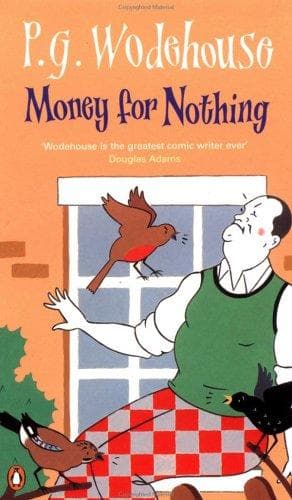
Money for nothingWodehouse, P. G. (Pelham Grenville)
General
Money for nothing
Wodehouse, P. G. (Pelham Grenville)
Greed -- Fiction; Humorous stories; Swindlers and swindling -- Fiction
Nevertheless, in spite of his uncle's solicitude nightfall found the
latter hurrying back into Worcestershire in the Widgeon Seven. He did
not admit that he was nervous, yet there had undoubtedly come upon
him something that resembled uneasiness. He had been thinking a good
deal during his ride to London about the peculiar behaviour of his
cousin Hugo on the previous night. The supposition that Hugo had found
Doctor Twist of Healthward Ho trying to burgle Rudge Hall was, of
course, too absurd for consideration, but it did seem possible that he
had surprised some sort of an attempt upon the house. Rambling and
incoherent as his story had been, it had certainly appeared to rest
upon that substratum of fact, and John had protested rather earnestly
to his uncle against being sent to London, on an errand which could
have been put through much more simply by letter, at a time when
burglars were in the neighbourhood.
Mr. Carmody had laughed at his apprehensions. It was most unlikely, he
pointed out, that Hugo had ever seen a marauder at all. But assuming
that he had done so, and that he had surprised him and pursued him
about the garden, was it reasonable to suppose that the man would
return on the very next night? And if, finally, he did return, the mere
absence of John would make very little difference. Unless he proposed
to patrol the grounds all night, John, sleeping as he did over the
stable yard, could not be of much help, and even without him Rudge
Hall was scarcely in a state of defencelessness. Sturgis, the butler,
it was true, must, on account of age and flat feet, be reckoned a
non-combatant, but apart from Mr. Carmody himself the garrison, John
must recollect, included the intrepid Thomas G. Molloy, a warrior at
the very mention of whose name Bad Men in Western mining camps had in
days gone by trembled like aspens.
It was all very plausible, yet John, having completed his business in
London, swallowed an early dinner and turned the head of the Widgeon
Seven homeward.
It is often the man with smallest stake in a venture that has its
interests most deeply at heart. His uncle Lester John had always
suspected of a complete lack of interest in the welfare of Rudge Hall;
and, as for Hugo, that urban-minded young man looked on the place as a
sort of penitentiary, grudging every moment he was compelled to spend
within its ancient walls. To John it was left to regard Rudge in the
right Carmody spirit, the spirit of that Nigel Carmody who had once
held it for King Charles against the forces of the Commonwealth. Where
Rudge was concerned, John was fussy. The thought of intruders treading
its sacred floors appalled him. He urged the Widgeon Seven forward at
its best speed and reached Rudge as the clock over the stables was
striking eleven.
Public-domain text, read in full here on John Shaqi.
Reviews
Reviews
No reviews yet
Be the first to share your thoughts on this work.
Elsewhere in the archive
Join the Discussion
Join the discussion
Sign in to leave a comment or review.
Sign InorCreate an account