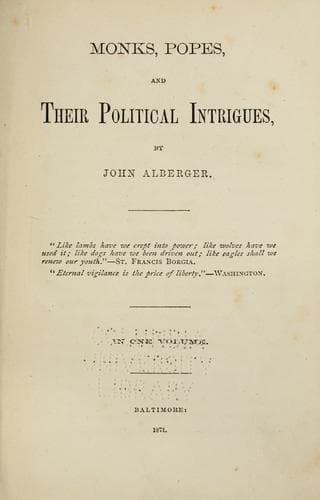
Monks, Popes, and their Political IntriguesAlberger, John
History
Monks, Popes, and their Political Intrigues
Alberger, John
Catholic Church; Catholic Church -- United States; Church and state
who, before the eyes of their father coldly butchered his five sons,
and then consummated the horrible tragedy with the murder of the emperor
himself. After this barbarous act had been perpetrated, Pope
Gregory, although he owed his elevation to the indulgence of Maurice,
complimented Phocus on his good fortune, and rejoiced that his piety and
benignity had raised him to the imperial throne.
From this model pope let us turn to Pope John XII., elected in 956. In
ambition unprincipled, in cruelty inexorable, in dissoluteness cold and
calculating; the annals of history scarcely furnish an equal compound of
moral deformity. Elevated to the papal throne through the influence of
a prostitute, he made the principles of his patroness the maxims of his
conduct. He was a drunkard, a profligate, a blasphemer, and a murderer.
He passed his time in hunting and gambling. He swore by the Pagan
Gods and Goddesses. He lived in public adultery with Roman matrons.
He converted the papal palace into a brothel, and made it a school for
education in the arts of prostitution. His rapes of widows, wives,
and virgins were so frequent, that female pilgrims were deterred from
visiting the tomb of St. Peter, for fear of being violated by the holy
father while kneeling at his shrine, to invoke his aid in the practice
of chastity and piety.
Now advert to Gregory VII., elected in 1075, and see what baseness,
trickery, avarice, and insolence have been consecrated as holy in the
character of a vicar of Christ. Protected from reproach by his claim
to infallibility, he presumed to outrage the sense of common decency
by living with the Countess Matilda under suspicious circumstances; and
conceiting that he was endowed with supreme power over all kings and
governments, and that if they resist his authority he must punish
them, he undertook to dethrone Henry IV., Emperor of Germany and Italy,
because that prince had exercised the right of investiture contrary to
the interdiction of the papal bulls. For this insolent proceed-ure the
emperor determined to depose him, and drive him from Rome. Penetrating
the emperor's design, he attempted to defeat it by buying the adherence
of the Italian populace; but this movement was effectually counterpoised
by the emperor's purchasing the support of the Italian nobility. He
also convened a council at by which Gregory was deposed; and another at
Brisen at which Clement III. was elected. To place Clement in possession
of the papal dignity, Henry formed a coalition with the Emperor Alexius:
to defeat this project Gregory formed an alliance with Robert Guiscard,
Duke of Apulia. The arms of Robert were victorious, and Gregory was
delivered from his perilous situation. But victory sometimes is as
disastrous as defeat. The formidable allies of the holy father, which
success had introduced into the city of Rome, comprehended a numerous
band of Saracens who hated the Christian name and capital, although they
Public-domain text, read in full here on John Shaqi.
Reviews
Reviews
No reviews yet
Be the first to share your thoughts on this work.
Elsewhere in the archive
Join the Discussion
Join the discussion
Sign in to leave a comment or review.
Sign InorCreate an account