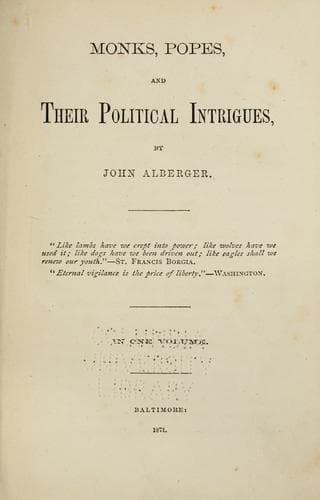
Monks, Popes, and their Political IntriguesAlberger, John
History
Monks, Popes, and their Political Intrigues
Alberger, John
Catholic Church; Catholic Church -- United States; Church and state
Let us now direct a moment's attention to Pope Innocent III, elected in
1198, who, when receiving the triple crown exclaimed: "The church has
given me a crown as a symbol of temporalities she has conferred on me a
mitre in token of spiritual power;--a mitre for the priesthood; a crown
for the kingdom; making me the vicar of him who bears on his garments
and thighs, 'The King of Kings, and Lord of Lords.'" Inflated with this
popular conceit he imagined that he was supreme prince over all nations
and kingdoms, and that he had a divine light to pluck up, destroy,
scatter, ruin, plant and build whenever a notion happened to inspire his
presumptuous brain. He arbitrarily obliged the prefect of Rome to swear
allegiance to him, demanded royal homage of Marguard of Romagna,
and upon the refusal of that prince to compromise his sov-reignty by
submitting to such unwarrantable dictations, deprived him of the duchy
of Mark Ancona. With a despotic hand he wrung Spoleto from Duke Conrad.
He excommunicated Philip of France for having repudiated his wife,
and obliged him to sue for mercy at his feet. He deposed King John, of
England, for refusing to confirm the election of a bishop; instigated
France to declare war against him, obliged him to resign his kingdom to
the See of Rome, to pay large sums of money for absolution, and to hold
his throne as a papal fief. He exercised an oppressive despotism over
the temporal provinces of Christendom, established inqisisitorial
tribunals, suspended religious worship by interdicts, and urged the
cruel persecution of the Albigenses.
When his military forces were ready for combat, he is said to have
exclaimed: "Sword, sword, whet thyself for vengeance."
Turn from this ornament of the papal throne, and consider the character
and administration of Pope Boniface VIII., elected in 1295. Pliable
and revengeful, presumptuous and ambitious, he sought to make tools of
princes, and slaves of subjects. On his way to the Lateran palace, after
his election, the King of Hungary and the King of Sicily, in token of
their inferior rank, held the bridle of his horse; and with crowns on
their heads waited on him at table as menials. He boldly excommunicated
Philip IV., of France, but cowardly sought to escape the penalty by
taking refuge in the fortress of Anangni. While luxuriating in this
sumptuous retreat, in fancied security, William of Nosgeret surrounded
the palace with three hundred horse, and a scuffle ensued in which the
vicegerent of God was rudely seized by the throat, severely kicked and
cuffed, and cast into prison. A mob, however, soon released him from
confinement. In view of his flagitious and undeniable acts of duplicity,
simony, usurpation and profligacy, King Philip had resolved to summon a
council at Lyons for the purpose of deposing him; but the chastisement
of incarceration which he had undergone so mortified his pride, that
within three days after his liberation he died in a paroxysm of rage and
fury.
Public-domain text, read in full here on John Shaqi.
Reviews
Reviews
No reviews yet
Be the first to share your thoughts on this work.
Elsewhere in the archive
Join the Discussion
Join the discussion
Sign in to leave a comment or review.
Sign InorCreate an account