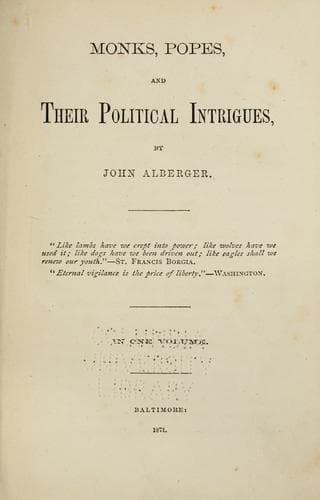
Monks, Popes, and their Political IntriguesAlberger, John
History
Monks, Popes, and their Political Intrigues
Alberger, John
Catholic Church; Catholic Church -- United States; Church and state
Turn to John XXII., elected in 1410, and see if any vice, public or
private, debarred a candidate from the papal throne. In his youth a
pirate, the sanctity of his pontifical character neither restrained nor
concealed the precocious viciousness which he had manifested. Although
he may have amused himself with the popish conceit that a holy father
cannot sin without being praised, yet the Council of Constance, on
the testimony of thirty-seven good Catholic witnesses, found seventy
indictments against him, and degraded him from the papal dignity. Among
the crimes for which he was deposed were simony, murder, rape, sodomy,
and illicit intercourse with his brother s wife, and with three hundred
nuns. This holy father died in jail.
Look at Julius III., elected in 1550, whose unnatural licentiousness
transcending all bounds of decency, sought its gratification with boys,
men, and even cardinals. Hear Sixtus V., in the college of cardinals,
pronouncing a eulogy on the assassinators of Henry III. King of France,
and comparing them with Judith and Eleazer. Hear Alexander I., as he
placed his foot on Frederic, King of Denmark, exclaim: "Thus shalt thou
tread upon the lion and the adder." Hear Pius V., as he excommunicated
Queen Elizabeth, exclaim: "I have this day set thee over the nations,
over the kingdoms, to root out, to pull down, to destroy, to build
up and to throw down." Witness Pope Leo III. abruptly crowning
Charlemagne, and to the astonishment of the world investing him with all
the titles, honors, and regal ornaments of the Cæsars. Witness Gregory
IV. fomenting discord between Charlemagne and his sons, then between the
sons themselves, then tampering with the officers of the imperial army,
then absolving them from their oath of allegiance, then uttering to
Louis I., son and successor of Charlemagne, that arrogant assertion:
"Know my chair is above the emperor's throne;" and ultimately see the
design of these atrocious acts, in the claim of the subsequent popes to
the dominion of the Cæsars, by virtue of the donation of Charlemagne.
Public-domain text, read in full here on John Shaqi.
Reviews
Reviews
No reviews yet
Be the first to share your thoughts on this work.
Elsewhere in the archive
Join the Discussion
Join the discussion
Sign in to leave a comment or review.
Sign InorCreate an account