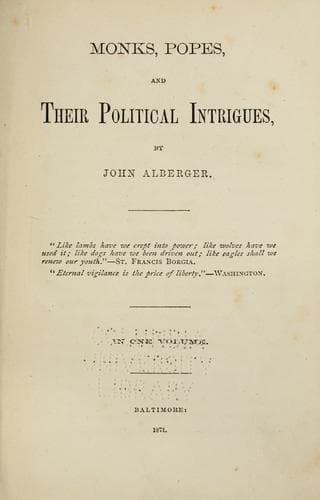
Monks, Popes, and their Political IntriguesAlberger, John
History
Monks, Popes, and their Political Intrigues
Alberger, John
Catholic Church; Catholic Church -- United States; Church and state
Pope Gregory declared that a council could be useful only under a
Catholic prince. Pius II. forbid an appeal to a council. Julius II.
interdicted the assembling of one after it had been summoned. When
the united voice of princes and subjects compelled Pius VII. to call a
council, he nullified his own summons by neglecting to fit the time for
its meeting. When a critical state of public affairs had led Pope Paul
to imagine that he could shape the proceedings of an inspired council
according to his private interest, he convoked the Council of Trent; but
finding his intrigues inadequate to his ambition, he induced his legates
to exhaust its time in frivolous ceremonies and useless excursions.
When the Council of Pisa obliged Alexander VII. to pledge his word to
prosecute certain specified reforms, he adopted no measure in compliance
with his word. When the Council of Basle enacted decrees of reform, the
artifice of Pope Eugenius rendered them of no avail. When the Council
of Constance, after deposing three rival popes, elected Martin V. in
consideration of the zeal with which he had advocated church reform,
it was soon apparent that his zeal for reform was his ambition to be
elevated to the papal throne, and that it all had expired as soon as his
election was secure. Pope Pius denounced the reforms which Joseph II.,
of Austria, proposed to introduce into his kingdom, and adopted every
expedient to counteract them: When the tyranny and profligacy of the
monastic orders had awakened the indignation of all Christendom, the
vicar of Christ, by means of bulls, anathemas and intrigues, defended
them with ferocious zeal. When the Jesuists were banished from England
for treasonable machinations, from Italy for profligacy, from Portugal
for attempts at assassination, and from the other parts of Europe for
execrable conduct, the popes not only defended, but recommended them as
the most pious and useful members of the church. When the papal throne
was restored by England, a heretic, and Russia, a schismatic, in
conjunction with the Catholic powers, after it had been abolished by
France, the pope, in defiance of the wishes and resolutions of his
liberators, and in violation of the obligations of honor and gratitude,
restored the barbarous inquisition, the obnoxious order of the Jesuists,
and the superstitious practices of the dark ages.
Public-domain text, read in full here on John Shaqi.
Reviews
Reviews
No reviews yet
Be the first to share your thoughts on this work.
Elsewhere in the archive
Join the Discussion
Join the discussion
Sign in to leave a comment or review.
Sign InorCreate an account