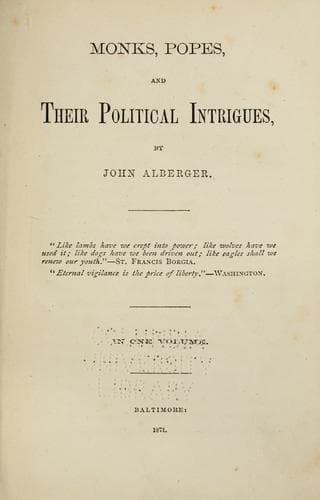
Monks, Popes, and their Political IntriguesAlberger, John
History
Monks, Popes, and their Political Intrigues
Alberger, John
Catholic Church; Catholic Church -- United States; Church and state
Another source of the pope's revenue is derived, from his foreign
possessions. These possessions consist of churches, monasteries,
nunneries, mission houses, edifices for schools, colleges, hospitals,
asylums, private dwellings, tracts of land, and every other species of
property. The papal foreign property is sometimes held in the name of
the pope, sometimes in that of a priest, and sometimes in that of
a corporation, real or pretended. Every priest coming to the United
States, in order that he may legally be qualified to hold property for
the benefit of the church, is required to take the oath of allegiance,
whether he considers it consistent or not with his ordination oath. (See
Hogan's Synopsis, p. 36). In 1822 the pope claiming to be the proprietor
of St. Mary's Church at Philadelphia, leased it to a foreign priest, and
sent him over to take charge of it. The trustees, and William Hogan, the
recognized encumbent, refusing to obey the order of the pope's agents,
a suit of ejectment was brought against them in the Supreme Court of
Pennsylvania. Judge Tilghman presided at the trial. He decided that the
pope could legally hold no property in the United States, and sustained
the action of the defendants. (See Hogan's Synopsis, pp. 113,114). In a
suit brought by the brothers of the order of Hermits of St. Augustine,
against the county of Philadelphia, for the destruction of St.
Augustine's Church by a mob of the American party, it was discovered
that the alleged corporation was entirely spurious. The pretended
corporators consisted of Micheal Hurly, pastor of St. Augustine's Church
at Philadelphia, Prince Gallager, pastor at Bedford, Pa., Lewis de
Barth, pastor of St. Mary's Church at Philadelphia, Patrick Henry,
pastor at Coffee Run, Chester County, Pa., and J. B. Holland, pastor at
Lancaster, Pa. So profoundly secret was the existence of this company
kept, that no laymen or priest outside of the pretended corporators had
ever heard of it before the trial, and as the public documents contained
no enrolment of it in accordance with the requirement of law, it was
pronounced entirely spurious and invalid. The value of the property held
in the name of this pretended corporation, in evasion of the laws of the
United States, was computed at 5,000,000 dollars. Even in cities where
the Catholic population is deemed numerically insignificant, millions
worth of property of which the inhabitants have not the slightest
conception, is owned by the pope, under cover of fictitious names or
otherwise. (See Hogan's Auric. Confess., vol. 2, p. 204, &c). Whenever
the church has obtained sufficient power she has made a bequest to the
coffers of the church a condition to the validity of a will; and where
she has failed to acquire this power, she has still exacted a compliance
with it from her members, under pain of her penalties. Splendid palaces
and gorgeous church edifices alone are not adequate to satisfy the
Public-domain text, read in full here on John Shaqi.
Reviews
Reviews
No reviews yet
Be the first to share your thoughts on this work.
Elsewhere in the archive
Join the Discussion
Join the discussion
Sign in to leave a comment or review.
Sign InorCreate an account