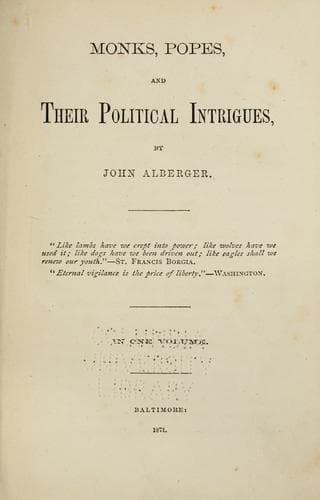
Monks, Popes, and their Political IntriguesAlberger, John
History
Monks, Popes, and their Political Intrigues
Alberger, John
Catholic Church; Catholic Church -- United States; Church and state
The obligation of all oaths of allegiance in conflict with the papal
clerical oaths, or the interests of the pope, are declared by the
universal authority of the church to be null and void. Dens says: "All
the faithful, also bishops and patriarchs, are bound to obey the Roman
pontiff. The pope hath also not only directive, but coactive power over
the faithful."--(De Eccles. No. 94, p. 439). Pope Urban, elected in
1087, says: "Subjects are not bound to observe the fealty which they
swear to a Christian prince, who withstands God and the saints, and
condemns the precepts."--(Pithon, p. 260). Pope Gregory IX says: "The
fealty which subjects have sworn to a Christian king, who opposes
God and his saints, they are not bound by any authority to
perform."--Decret., vol. 1, p. 648). Again he says: "An oath contrary to
the utility of the church is not to be observed."--Vol. 2, p. 358.) And
again he asserts: "You are not bound by an oath of this kind, but on
the contrary you are freely bid Good-speed in standing against kings
for the rights and honors of that very church, and even in legislatively
defending your own peculiar privileges."--(Vol. 2.. p. 360). Bronson,
speaking of the church says: "As the guardian and judge of law she must
have power to take cognizance of the State, and to judge whether or not
it does conform to the condition and requirement of its trust, and to
pronounce sentence accordingly."--(Rev. Jan. 1854) Pope Pius V., in
relation to Queen Elizabeth, said: "We do declare her to be deprived of
her pretended right to the kingdom, and of all dominion whatsoever; and
also the subjects sworn to her to be forever dissolved from any such
oath." Pope Innocent III., elected in 1198, "Freed all that were bound
to those who had fallen into heresy, from all fealty, homage, and
obedience."--(Pithon, p. 24).
Bronson says: "Rome divided her British territory into dioceses, and
sends cardinals to London, notwithstanding the laws that England shall
not thus be divided."--(Rev., April, 1854). The trustees of the church of
St. Louis, at Buffalo, N. Y., having refused to comply with the canons
of the Council of Trent in violating the trust laws of the State of New
York, the bishop proceeded to excommunicate them. In consequence of this
conduct, the legislature of 1855 passed an act defining ecclesiastical
tenure. In a letter of Bishop Hughes, dated March 28th, 1855, and
published in the _Freeman's Journal_, respecting this law, he says:
"Now in this it seems to meddle with our religion, as well as our civil
rights; and we shall find twenty ways outside the intricate web of its
prohibitions for doing, and doing more largely still, the very thing it
wishes us not to do."
Public-domain text, read in full here on John Shaqi.
Reviews
Reviews
No reviews yet
Be the first to share your thoughts on this work.
Elsewhere in the archive
Join the Discussion
Join the discussion
Sign in to leave a comment or review.
Sign InorCreate an account