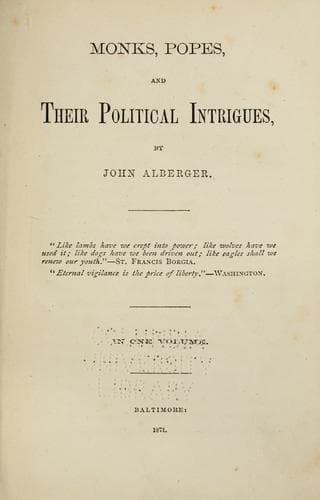
Monks, Popes, and their Political IntriguesAlberger, John
History
Monks, Popes, and their Political Intrigues
Alberger, John
Catholic Church; Catholic Church -- United States; Church and state
Passing by the numerous instances of papal political intrigue in the
history of England, we will glance at a few of those which have taken
place since the coronation of Henry II., in 1154. The most accomplished
prince of his time, and celebrated for the acuteness of his judgment
and the equitableness of his decisions, he received at the hands of his
regal cotemporaries the distinguished honor of being chosen by them as
their arbiter, to settle their matters of dispute. He received also,
from the policy or generosity of Pope Adrian IV., a gift of the kingdom
of Ireland. The following extract from Adrian's bull on that occasion
will explain the nature and object of the donation: "No one doubts, and
you know the fact yourself, that Ireland, and all the isles that have
received the Christian faith belong to the church of Rome. And you have
signified to us that you wish to enter this island, in order to subject
the people to the laws, and extirpate their vices; to make them pay to
St. Peter a penny a year for each house, and preserve in all things
the rights of the church; which we grant to you with pleasure for
the increase of the Christian religion."--(Labb. 13, 14, 15). At the
dictation of the pope, the Irish clergy met at Waterford and took the
oath of allegiance to Henry and his successors. Thus by a pretended
prerogative of popery, "Ireland was blotted from the map, and
consigned to the loss of freedom, without a tribunal and without a
crime."--(McGeoghegan, 1: 440). But notwithstanding the munificent
bounty of the pope, yet the growing weight of the ecclesiastical
establishments--so oppressive to the industry and enterprise of the
people--and the continual and insidious encroachments of the clergy
on the prerogatives of the crown, determined Henry, under the
administration of Pope Alexander III., to summon a council of nobles and
clergy at Clarendon, to frame such a constitution as would be adequate
for the protection of the prerogatives of the crown and the rights of
the subjects. The principles of this constitution, like seeds sown among
thorns and brambles, were in danger of being oppressed in their early
growth by a heavy encumbrance of Catholic ignorance and superstition;
and not until intelligence and public spirit had removed the obstruction
did they show their native benificent vigor. Under the stormy reign of
Henry II. they were checked, thwarted, and at times almost extirpated;
but under that of King John they produced the "Magna Charta," under that
of Charles II. the "Habeas Corpus," and under those of succeeding princes
the various liberal acts which constitute English liberty.
Public-domain text, read in full here on John Shaqi.
Reviews
Reviews
No reviews yet
Be the first to share your thoughts on this work.
Elsewhere in the archive
Join the Discussion
Join the discussion
Sign in to leave a comment or review.
Sign InorCreate an account