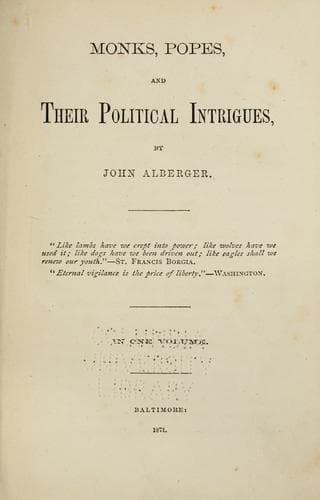
Monks, Popes, and their Political IntriguesAlberger, John
History
Monks, Popes, and their Political Intrigues
Alberger, John
Catholic Church; Catholic Church -- United States; Church and state
To add to the public dissatisfaction the Duke of York, the heir
presumptive to the throne, openly espoused the cause of Catholicism.
Strong measures were consequently adopted to remove him from his post,
as admiral of the navy, and eventually to exclude him from the throne.
The violent factions, and fierce criminations and recriminations to
which these measures gave rise kept the people in a state of feverish
excitement. In the midst of these wild alarms a pretended popish plot
was reported to have been discovered, which received universal credence.
The design of this plot was said to be to destroy parliament and
assassinate the king. A secret Catholic faction was supposed to exist
in the nation, the object of which was to restore the authority of the
pope; and circumstances lending credibility to the supposition, the most
intense excitement seized the public mind. Parliament was terrific in
its denunciations, and the people clamorous for vengeance. Lords were
arrested, priests hung, the Duke of York fled from the country in
terror, the Earl of Stafford was beheaded, and the king, filled with
consternation, yielded to the popular demand the Habeas Corpus act, to
avert the storm that was muttering destruction over his head. Fortified
with this new safeguard to public freedom, the people became tranquil
once more; but the king perceiving the formidable obstacle which
parliament obtruded in the way of his acquisition of despotic power,
resolved to get rid of it by making it the instrument of its own
destruction. After having assembled it several times for this purpose,
and finding it inflexibly opposed to his measures, he determined to
dispense with it altogether, and to substitute his prerogatives in
the place of its authority. In order to reduce the corporations to an
absolute dependence on his will, he employed with as much baseness as
tyranny, intimidations to induce them to surrender their charters,
so that they might be remodelled in accordance with the claims of the
absolute power of his prerogatives. In order to deplete the ranks of
non-Catholics, he had recourse to gross and unfounded charges of plots
and conspiracies. Lord Shaftsbury, the author of the Habeas Corpus act,
was arrested, imprisoned in the Tower and tried for high treason; but
acquitted. Dungeons were overcrowded with subjects against whom no
allegation laid, except that of love of liberty and opposition to
tyranny. But while he was wading through the innocent blood of his
subjects to a crown of unlimited monarchy, some desperate spirits
were secretly concocting a plot to arrest his atrocious career by the
deplorable means of the assassin's dagger. This unsuccessful conspiracy,
known as the Rhyhouse plot, which could not escape the omniscient eye of
the Catholic machinery, was, of course, discovered before it had matured
its plans, and only gave the king a plausible pretence for gratifying
his malignancy against the ablest advocates of constitutional liberty.
Public-domain text, read in full here on John Shaqi.
Reviews
Reviews
No reviews yet
Be the first to share your thoughts on this work.
Elsewhere in the archive
Join the Discussion
Join the discussion
Sign in to leave a comment or review.
Sign InorCreate an account