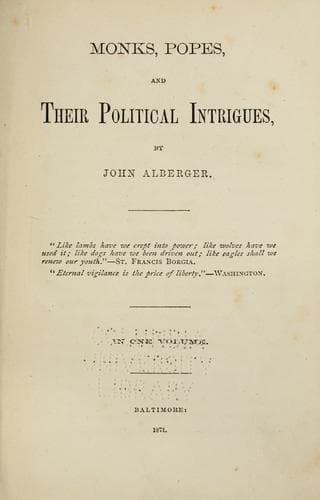
Monks, Popes, and their Political IntriguesAlberger, John
History
Monks, Popes, and their Political Intrigues
Alberger, John
Catholic Church; Catholic Church -- United States; Church and state
The last survivor of the Carlovingian dynasty was Charles, Duke of
Lorraine. The subjects of the realm at that period had become greatly
dissatisfied concerning the oppressive privileges which the clergy
enjoyed, as well as with the impoverishing exactions which they extorted
from their industry. With these popular grievances the temper and
disposition of Charles engaged his warmest sympathies. Pope John XVI.,
elected in 986, perceiving that the heir presumptive to the throne
would, when he acceded to power, listen to the complaints and lessen the
burdens of his subjects; and acting on the historic motive of the Holy
See, in making rulers its tools, and changing dynasties to suit its
purposes, induced the Frankish nobility to proclaim Hugh Capet King
of France. But before this sycophantic papal favorite could be crowned
king, and anointed with the holy oil, he was obliged to swear to
preserve the clergy in all the privileges and immunities which they
enjoyed. Against this formidable conspiracy Charles found himself
powerless; and after making some demonstrations against the usurper,
retired to Lyons, which place was capable of withstanding a vigorous
siege. With great skill and energy, but without any flattering success,
his adversary assailed the strong-built fortifications. The success
which valor denied was, however, accorded by treachery. The bishop of
the city having entered into secret negotiations with Capet, the gates
were thrown open at midnight; and the usurper entering the precincts
amid the stillness of the hour captured the royal family, surprised
Charles in bed and threw him into prison, from which he was never
liberated. The Capitian dynasty, thus founded in fraud, violence and
usurpation, and unsupported by a shadow of legal right, stands forth
in history as the grand champion of the legitimacy of kings, or their
divine right to rule by virtue of their descent, independent of the
consent of the governed. The dynasties of empires and the political
events of nations are so intimately connected with the domestic affairs
of royal families, that in order to control the one, papal intrigue has
constantly intermeddled with the other, Robert II., who became king
of France in 997, married Bertha, his cousin, a lady of inestimable
qualities. The royal pair were a model of connubial loveliness and
felicity; but when an heir had completed the perfection of their
happiness the pope interfered, and by the exercise of his sacred
authority, embittered the remainder of their existence. Robert not
having purchased of the church an indulgence for marrying a cousin, Pope
Sylvester II. pronounced the conjugal union illegal, and commanded the
king to abandon his wife. To be guilty of an offence of such a henious
character against the most amiable of women; to act in violation of
all his matrimonial vows and obligations; to spurn his lawful wife as a
prostitute, and to declare his children bastards, was a complication of
Public-domain text, read in full here on John Shaqi.
Reviews
Reviews
No reviews yet
Be the first to share your thoughts on this work.
Elsewhere in the archive
Join the Discussion
Join the discussion
Sign in to leave a comment or review.
Sign InorCreate an account