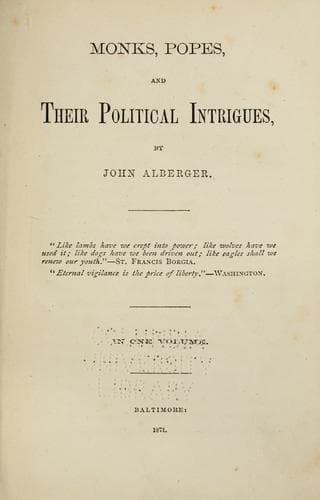
Monks, Popes, and their Political IntriguesAlberger, John
History
Monks, Popes, and their Political Intrigues
Alberger, John
Catholic Church; Catholic Church -- United States; Church and state
This proposition startled Henry; he saw the ambitious designs of the
pope, and he felt the importance of checking them. Boldly denying the
papal pretensions, and rejecting with indignant contempt the proposition
of Paschal, he marched his army on Rome, dragged the pope from the altar
while he was celebrating mass, and casting him into prison, determined
that he should there remain until he consented to crown him without any
condition. To be restored to liberty and luxury the pope acceded to all
the terms dictated to him by the emperor, but with a secret disposition
to render them nugatory at the first opportunity. Disturbances occurring
in Germany, the pope was agreeably relieved of the embarrassing
restraints of the emperor's presence. To suppress the Germanic
revolution the skill and valor of Henry was occupied for two years. In
the meantime the pope, in order to nullify the concessions which he had
made, organized an Italian conspiracy against the emperor. Soon as Henry
had quelled the insubordination in Germany, he therefore returned to
Italy to punish the author of the calamities of his reign. But Pope
Paschal evaded the designed chastisement by absconding to Apulea, where
he shortly afterwards died.
Pope Galatius II., an enemy of Henry, having obtained the papal dignity,
the latter deposed him, and caused Bourden, under the name of Gregory
VIII., to be substituted in his place. The deposed pope and his
cardinals, having the control of the papal machinery, were enabled to
oppose, with great success, the policy of Henry in every part of
his dominion. Galatius assembled a council of bishops at Vienna and
excommunicated him; Calaxtus II. convened one at Rheims, and repeated
the sentence; the nobles broke out in frequent rebellion; and finally
such insubordination prevailed in the empire, and such violent outbursts
so frequently disturbed the public peace, that in order to restore
tranquillity Henry was compelled to subscribe to a concordat at Worms,
in which he renounced the right of investiture, and to any interference
in the consecration of bishops.
Public-domain text, read in full here on John Shaqi.
Reviews
Reviews
No reviews yet
Be the first to share your thoughts on this work.
Elsewhere in the archive
Join the Discussion
Join the discussion
Sign in to leave a comment or review.
Sign InorCreate an account