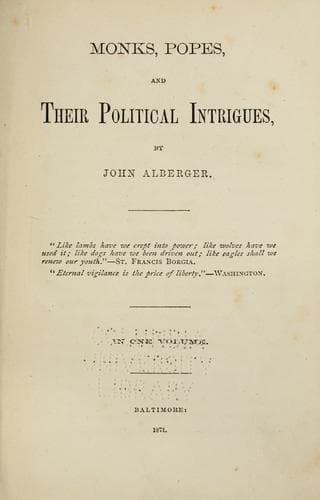
Monks, Popes, and their Political IntriguesAlberger, John
History
Monks, Popes, and their Political Intrigues
Alberger, John
Catholic Church; Catholic Church -- United States; Church and state
clotted with the blood of generations, surrounded by broken sceptres and
crushed thrones, with its feet on the neck of kings and people, and its
usurping hand grasping at the crowns of earth, heaven and hell, a murmur
of horror broke from the lips of the world. Then learning began to
scoff at its claims, research to expose its frauds, wit to ridicule
its pretensions; and then religious liberty, through the Albigenses and
Waldenses uttered that memorable peal, which is destined to reverberate
as an undying tone through all future ages. Then arose the free cities
from their long degradation, and began to perfect their internal
organizations by the establishment of corporations; then appeared the
first universities, arousing the dormant spirit of free inquiry and
investigation; then the abrogation of the system of violence began to
restore public security; and then the separate members of the empire
began to be assembled and deliberate on public affairs, originating the
principle of the provincial diets.
Frederic II., son of the emperor Henry VI., was born at this illustrious
period of German history. Philip, Duke of Suabia, was nominated
regent during Frederic's minority, but the pope, wishing a more pliant
instrument, substituted Berthold. Finding this scheme impracticable he
recommended Otho, and Philip being murdered, the papal policy succeeded.
But the pope soon found that his intrigue had vested with power a mortal
foe to the Papal See. For Otho clearly manifested a design of not only
wresting Sicily from Frederic, which the latter inherited from his
mother, princess of Constance, but of establishing the authority
of Germany over certain possessions of Italy which it claimed as an
inheritance. To counteract the mistake of his policy the pope took
Frederic under his protection, and called into requisition all the power
of his machinery. At the age of twenty-one years he crowned his protege
Emperor of Germany; but in order to bind him to his interests he exacted
a coronation oath that he would undertake a crusade in behalf of the
church. Frederic, enjoying the favor and influence of the pope, and
the advantageous co-operation of his machinery, soon defeated Otho, and
became sole sovereign of the empire.
Public-domain text, read in full here on John Shaqi.
Reviews
Reviews
No reviews yet
Be the first to share your thoughts on this work.
Elsewhere in the archive
Join the Discussion
Join the discussion
Sign in to leave a comment or review.
Sign InorCreate an account