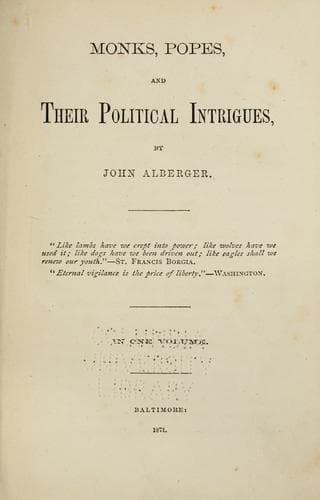
Monks, Popes, and their Political IntriguesAlberger, John
History
Monks, Popes, and their Political Intrigues
Alberger, John
Catholic Church; Catholic Church -- United States; Church and state
In 1826 John VI. died, and Isabella becoming regent, administered the
government until Pedro IV. of Brazil, the brother of the deceased king,
could make it convenient to visit Portugal, and assume the reigns
of government. After having done so he established a constitution,
providing two legislative chambers, and then abdicated in favor of his
eldest daughter, Dona Maria da Gloria. Don Miguel, his brother, the
chamberlains, and the magistrates swore to support the constitution. But
the first, in violation of his oath of allegiance, and of his fraternal
obligations, entered into a conspiracy for its overthrow. With this
object in view he organized an apostolic party, and abusing the power
and confidence with which he was honored, secretly filled the army,
navy, and civil offices with his adherents. Having matured his plans
he caused an insurrection to break out against the queen, in order to
enable him to seize the royal authority under pretense of restoring
public tranquillity. England, however, interfering, the revolution was
checked, and the project of usurpation frustrated. But the treasonable
plot was skilfully and comprehensively laid, and the zealous support
which it derived from the papal machinery soon rendered it popular with
the masses. As if enamored of slavery and despotism, the people began to
crowd into the ranks of the apostolic party, to second its declaration
in favor of Don Miguel as king, to unite in its shouts of "Long live the
absolute king," "Down with the constitutions," and to denounce, abuse
and assault those who refused to echo its suicidal acclamations. A few
military garrisons which still withstood the popular frenzy, and adhered
to the cause of constitutional government, raised the standard of
revolt; and being joined by other troops, an army was organized which
marched against Lisbon. It was met by the apostolic army, which greatly
outnumbered it; and being defeated, the liberal junta was dissolved and
Don Miguel proclaimed absolute king. In 1834 Don Miguel was defeated by
Don Pedro IV., and the constitution of 1826 was re-established by the
cortes.
PAPAL POLITICAL INTRIGUES IN SPAIN
We will conclude our history of Papal Political Intrigues, by a cursory
glance at a few of its instances with regard to the government of Spain.
Catholicism was introduced into Spain in 586, under the reign of
Reccared I.; and from that period the governmental affairs were
controlled by the political intrigues of the clergy, until 711, when the
kingdom became a province of the Caliph of Bagdad.
Public-domain text, read in full here on John Shaqi.
Reviews
Reviews
No reviews yet
Be the first to share your thoughts on this work.
Elsewhere in the archive
Join the Discussion
Join the discussion
Sign in to leave a comment or review.
Sign InorCreate an account