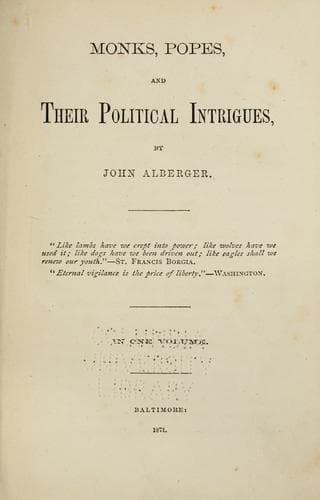
Monks, Popes, and their Political IntriguesAlberger, John
History
Monks, Popes, and their Political Intrigues
Alberger, John
Catholic Church; Catholic Church -- United States; Church and state
Although his Catholicism had transformed him into merely mechanical part
of the papal machinery, without feeling or reason, yet when his truce
with France was broken by the interference of Pope Paul IV., and his
right to the kingdom of Naples was declared forfeited, he awoke from his
lethargic slumbers, and commissioned the bloody Alva to proceed with an
army to Rome and chastise the holy father for his insulting political
intrigues. The pope alarmed, and, perhaps surprised at the belligerent
attitude of a king once so remarkably obedient, thought it better to
consult prudence than the divine prerogatives of his office, and to
avert the impending chastisement by subscribing to articles of peace.
In 1169 Philip III. became invested with the royal dignity. By nature
a tyrant, by temper a bigot, without any administrative capacity, and
educated in superstition and intolerance, he seems to have been born for
the the disgrace and destruction of the throne he inherited. In the
most brilliant period of Spanish history her religious despotism was
prophetic of her premature decay, and each succeeding reign verifying
the prophecy, she now tottered on the verge of ruin. Favorites were
allowed to waste the national revenues, England and Holland destroyed
the Spanish commerce, frequent insurrections destroyed the public peace;
eight hundred thousand Jews, and two million Moors were, during this and
the preceding administration driven from the country; and to complete
the national degradation Spain had to submit to the supremacy of
England.
In 1665 Charles II. succeeded to the regal authority. At his death,
which occurred in 1700, he made Philip of Anjou, grandson of his sister,
consort of Louis XIV., the sole heir of his dominion, in order to
prevent the division of the empire, which had been resolved upon by
France, England and Holland. This will led to the war of the Spanish
succession, notwithstanding which the Bourbon, Philip V., maintained
himself on the Spanish throne.
Public-domain text, read in full here on John Shaqi.
Reviews
Reviews
No reviews yet
Be the first to share your thoughts on this work.
Elsewhere in the archive
Join the Discussion
Join the discussion
Sign in to leave a comment or review.
Sign InorCreate an account