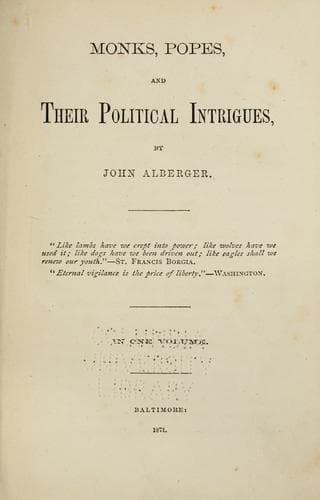
Monks, Popes, and their Political IntriguesAlberger, John
History
Monks, Popes, and their Political Intrigues
Alberger, John
Catholic Church; Catholic Church -- United States; Church and state
Peace being restored to the nation the cortes assembled, and shortly
afterwards passed a resolution, declaring that before Ferdinand should
be acknowledged as king, he should be required to swear to support the
constitution which had been drawn up by the cortes of 1812, and which
had been acknowledged by the allies of Spain. When interrogated as to
his disposition of complying with the demands of the cortes, he replied
in a tone of insolent indifference: "I have not thought about it." To
fortify the absolute power he intended to usurp he professed to abhor
despotism, and solemnly pledged his honor to grant the people a new
constitution, founded on liberal principles, and which would afford
ample protection to the rights of person and property, and to the
freedom of the press. But the motives which induced him to make these
promises did not urge him to fulfil them. While he nullified the old
constitution, he did not restrict his authority by a new one; but in the
exercise of absolute power arrested the officers who served under Joseph
Bonaparte, and banished them with their wives and children; abolished
freemasonry; restored the Jesuists; re-established the inquisition;
put liberals to the rack; executed all who opposed the domineering
pretensions of the priests; imprisoned those who ventured to remonstrate
against his measures; incarcerated in monastic dungeons the members of
the cortes; and domineered with absolute despotism over the lives
and fortunes of his subjects. These severe proceedings, intended to
intimidate insurgents, produced disloyalty, confusion and anarchy. The
army became dissatisfied; the people insubordinate; the country infested
with plundering and murdering guerillas; and, encouraged by this
turbulent state of affairs, four battalions, in 1819, under Riago,
declared for the constitution of 1812. The progress of this revolution
was strenuously opposed by the allied forces of the monks, the priests,
and the absolutists. The bishop of Cienfuegos defeated it at Cadiz. But
the people inhaling the patriotic enthusiasm, arose in masses in its
favor, and even the apostolics deserted their commanders. Ferdinand
deprived of troops, and almost of adherents, found himself obliged to
submit to the demands of the people. A provisional junta was established
to conduct-the public affairs, before which Ferdinand appeared and swore
to support the constitution of 1812. The inquisition was abolished. The
cortes assembled, and in a session of four months, endeavored by the
means of moderate measures to conciliate the prejudices and interests of
contending factions, and to restore harmony and vigor to the nation. The
clergy and absolutists, whom no concession could satisfy, except that of
unrestricted monarchy, organized a conspiracy for the overthrow of
the constitution; and as the cortes had in their reformatory measures
abolished some convents, and banished all non-juring priests, they
Public-domain text, read in full here on John Shaqi.
Reviews
Reviews
No reviews yet
Be the first to share your thoughts on this work.
Elsewhere in the archive
Join the Discussion
Join the discussion
Sign in to leave a comment or review.
Sign InorCreate an account