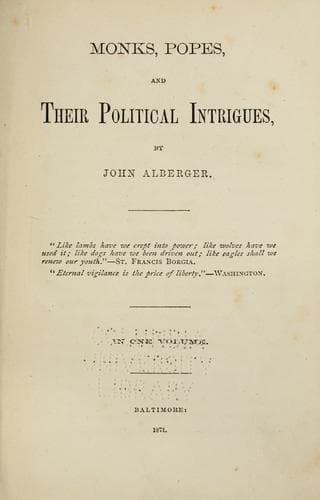
Monks, Popes, and their Political IntriguesAlberger, John
History
Monks, Popes, and their Political Intrigues
Alberger, John
Catholic Church; Catholic Church -- United States; Church and state
The dictatorial interference of foreign powers in the internal affairs
of a sovereign nation, and their attempts to defeat a governmental
reform which they had sanctioned, and which, to achieve had cost the
nation so much treasure, and so many valuable lives, fired the native
pride and heroism of the Spanish character, and united the different
factions of the constitutionalists in a solid body in favor of their
country and its liberty. Though few in number, without allies, and
without pecuniary resources, yet they were full of energy and heroic
courage. The cortes repelled with patriotic indignation the insolent
interposition of foreign powers, and prepared for the doubtful contest
with consummate skill. As the church had been the chief cause of the
national calamity, they appropriated its surplus plate to the necessity
of the public treasury. The soldiers of the faith, and their guerilla
bands, exclusively requiring the attention of the national guards and
of the soldiers of the line, the cortes found themselves without
an efficient army to oppose the march of the French troops, and the
apostolic forces. This serious disadvantage enabled the absolutists to
march oh from victory to victory; and though some places made a good
defence, and others a stubborn and desperate resistance, yet others
submitted with scarcely a struggle. The gloom which now overshadowed
the prospects of the constitutionalists, was ominously deepened by the
defection of some of their generals. But the undaunted firmness of
the remaining leaders, and the unequalled boldness and skill which
characterized their manoeuvres, desperately disputed inch by inch the
progress of the monarchists, until the fall of Valencia terminated
the eventful struggle, so honorable to the constitutionalists, so
disgraceful to Europe, and so full of admonition to freemen. The bloody
contests in which the liberals had been engaged greatly depleted their
ranks, and now dungeons, exile, and the secret dagger nearly completed
their annihilation. Under these depressing circumstances, the cortes
invested Ferdinand with absolute power. The apostolics, the soldiers
of the faith, the clergy and the uneducated classes, hailed him with
acclamations of "Long live the absolute king;" "Long live religion;"
"Death to the nation;" "Death to the negroes." Ferdinand then declared
null and void all the acts of the constitutional government, and all the
public approvals by which he had sanctioned them. An attempt was made
to introduce the inquisition, but the liberals, supported by France, and
even approved by the pope, successfully resisted the obnoxious measure.
In 1832, the infirmities of Ferdinand having rendered him the dupe of
designing favorites, he created Christina, the queen, regent for the
infanta Isabella, his daughter. In 1837 the regent was obliged, by an
insurrection, to proclaim the constitution of 1812. In 1843, Isabella
having attained her majority, was declared queen. The constitution,
Public-domain text, read in full here on John Shaqi.
Reviews
Reviews
No reviews yet
Be the first to share your thoughts on this work.
Elsewhere in the archive
Join the Discussion
Join the discussion
Sign in to leave a comment or review.
Sign InorCreate an account