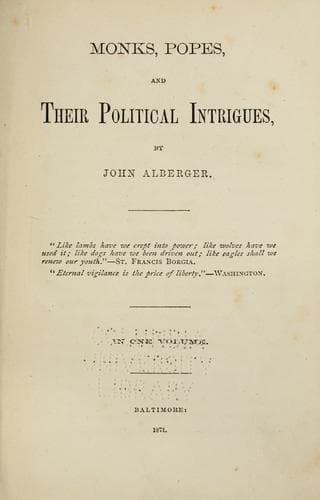
Monks, Popes, and their Political IntriguesAlberger, John
History
Monks, Popes, and their Political Intrigues
Alberger, John
Catholic Church; Catholic Church -- United States; Church and state
"In 1852 our presidential vote was about 3,300,000. In 1848 it was about
2,880,000. In 1852 our foreign arrivals, as shown, were about 400,000,
and 240,000 of these were males, thus showing that in one year, the
arrivals of foreign males into this country, was nearly as great as the
increase of our whole voting population during four years."
IN THE UNITED STATES.
The foreign arrivals by sea alone were--
"In 1850 315,333
"1851 403,828
"1852 398,470
"1853 400,777
From Canada and Mexico during the same
period about 700,408
2,118,408
It appears from the census of 1850 that the total aggregate of foreign
population of the United States in 1849 was 2,210,829. If the tide of
immigration has added but two millions to the number of the foreign
population every four years since 1849, it must have amounted, in 1869,
to 7,210,829.
All the immigrants are not, however, Catholics. Some are Protestants,
some Infidels, and some Radical Republicans. The Turners, the Free
Germans, and the members of the Revolutionary League are all firm
friends of free governments. The proportion of Catholics among the
immigrants, at a fair computation, is presumed to be about three-fourths
of the entire number. They must, therefore, add to the Catholic
numerical strength about 3,750,000 at every decade, besides the
numerical augmentation of the Catholic church through the medium of
foreign immigration, there are other appliances acting powerfully in its
favor. "It is not long," says William Hogan, "since I saw a-letter from
the Catholic bishop Kendrick, of the diocese of Massachusetts, in which
he informs the authorities of Rome that he is making converts of some of
the first families in the diocese."--_Synopsis_, p. 169. "I have often
conversed," says he, "with American Protestants on this subject,
and regret finding many of them--especially those of the Unitarian
creed--are strong advocates of popery, and in favor of its introduction
among the people." John L. Chapman, a Methodist clergyman, in a work
written before the Southern outbreak, says in substance, according to
my recollection, that a Methodist preacher cannot now address his
congregation upon the subject of Catholicism with the same freedom he
could formerly; that those who imagine a Methodist preacher can now
utter in the pulpit, or at a tract or bible meeting, the sentiments of
John Wesley respecting popery, are entirely mistaken; and that those
who suppose that an editor of a Methodist periodical can now assail
the errors of Catholicism without the loss of subscribers, are laboring
under a great delusions. While the pulpits, revivals, and evangelical
Public-domain text, read in full here on John Shaqi.
Reviews
Reviews
No reviews yet
Be the first to share your thoughts on this work.
Elsewhere in the archive
Join the Discussion
Join the discussion
Sign in to leave a comment or review.
Sign InorCreate an account