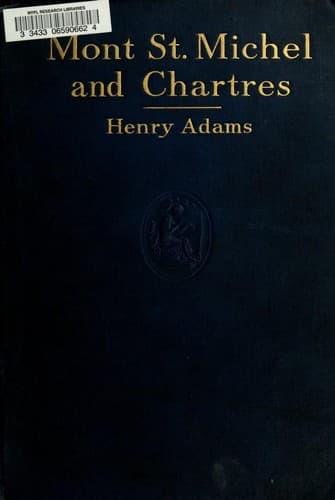
Cathédrale de Chartres; Civilization, Medieval; Mont-Saint-Michel (Abbey : France)
want is not the feeling of the artist so much as the feeling of
Chartres. What shall it be--the jewelled brilliancy of the western
windows, or the fierce self-assertion of Pierre Mauclerc, or the
royal splendour of Queen Blanche, or the feminine grace and
decorative refinement of the Charlemagne and Santiago windows in the
apse?
Never again in art was so splendid a problem offered, either before
or since, for the artist of Chartres solved it, as he did the whole
matter of fenestration, and later artists could only offer
variations on his work. You will see them at Bourges and Tours and
in scores of thirteenth and fourteenth and fifteenth and sixteenth
century churches and windows, and perhaps in some of the twentieth
century,--all of them interesting and some of them beautiful,--and
far be it from us, mean and ignorant pilgrims of art, to condemn any
intelligent effort to vary or improve the effect; but we have set
out to seek the feeling, and while we think of art in relation to
ourselves, the sermon of Chartres, from beginning to end, teaches
and preaches and insists and reiterates and hammers into our torpid
minds the moral that the art of the Virgin was not that of her
artists but her own. We inevitably think of our tastes; they thought
instinctively of hers.
In the transepts, Queen Blanche and Duke Perron, in legal possession
of their territory, showed that they were thinking of each other as
well as of the Virgin, and claimed loudly that they ought each to be
first in the Virgin's favour; and they stand there in place, as the
thirteenth century felt them. Subject to their fealty to Mary, the
transepts belonged to them, and if Blanche did not, like Pierre,
assert Herself and her son on the Virgin's window, perhaps she
thought the Virgin would resent Pierre's boldness the more by
contrast with her own good taste. So far as is known, nowhere does
Blanche appear in person at Chartres; she felt herself too near the
Virgin to obtrude a useless image, or she was too deeply religious
to ask anything for herself. A queen who was to have two children
sainted, to intercede for her at Mary's throne, stood in a solitude
almost as unique as that of Mary, and might ignore the raw
brutalities of a man-at-arms; but neither she nor Pierre has carried
the quarrel into Mary's presence, nor has the Virgin condescended
even to seem conscious of their temper. This is the theme of the
artist--the purity, the beauty, the grace, and the infinite
loftiness of Mary's nature, among the things of earth, and above the
clamour of kings.
Public-domain text, read in full here on John Shaqi.
Reviews
Reviews
No reviews yet
Be the first to share your thoughts on this work.
Elsewhere in the archive
Join the Discussion
Join the discussion
Sign in to leave a comment or review.
Sign InorCreate an account