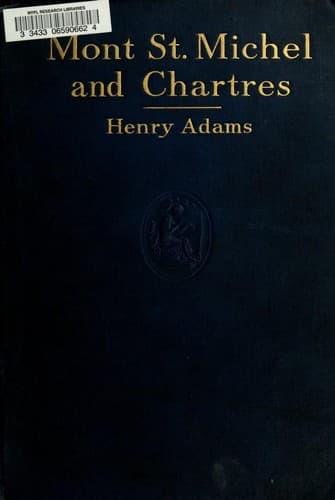
Cathédrale de Chartres; Civilization, Medieval; Mont-Saint-Michel (Abbey : France)
This little thirteenth-century gem is called a "chante-fable," a
story partly in prose, partly in verse, to be sung according to
musical notation accompanying the words in the single manuscript
known, and published in facsimile by Mr. F. W. Bourdillon at Oxford
in 1896. Indeed, few poems, old or new, have in the last few years
been more reprinted, translated, and discussed, than "Aucassins,"
yet the discussion lacks interest to the idle tourist, and tells him
little. Nothing is known of the author or his date. The second line
alone offers a hint, but nothing more. "Caitif" means in the first
place a captive, and secondly any unfortunate or wretched man.
Critics have liked to think that the word means here a captive to
the Saracens, and that the poet, like Cervantes three or four
hundred years later, may have been a prisoner to the infidels. What
the critics can do, we can do. If liberties can be taken with
impunity by scholars, we can take the liberty of supposing that the
poet was a prisoner in the crusade of Coeur-de-Lion and Philippe-
Auguste; that he had recovered his liberty, with his master, in
1194; and that he passed the rest of his life singing to the old
Queen Eleanor or to Richard, at Chinon, and to the lords of all the
chateaux in Guienne, Poitiers, Anjou, and Normandy, not to mention
England. The living was a pleasant one, as the sunny atmosphere of
the Southern poetry proves.
Dox est li cans; biax est li dis,
Et cortois et bien asis.
The poet-troubadour who composed and recited "Aucassins" could not
have been unhappy, but this is the affair of his private life, and
not of ours. What rather interests us is his poetic motive,
"courteous love," which gives the tale a place in the direct line
between Christian of Troyes, Thibaut-le-Grand, and William of
Lorris. Christian of Troyes died in 1175; at least he wrote nothing
of a later date, so far as is certainly known. Richard Coeur-de-Lion
died in 1199, very soon after the death of his half-sister Mary of
Champagne. Thibaut-le-Grand was born in 1201. William of Lorris, who
concluded the line of great "courteous" poets, died in 1260 or
thereabouts. For our purposes, "Aucassins" comes between Christian
of Troyes and William of Lorris; the trouvere or jogleor, who sang,
was a "viel caitif" when the Chartres glass was set up, and the
Charlemagne window designed, about 1210, or perhaps a little later.
When one is not a professor, one has not the right to make inept
guesses, and, when one is not a critic, one should not risk
confusing a difficult question by baseless assumptions; but even a
summer tourist may without offence visit his churches in the order
that suits him best; and, for our tour, "Aucassins" follows
Christian and goes hand in hand with Blondel and the chatelain de
Coucy, as the most exquisite expression of "courteous love." As one
of "Aucassins'" German editors says in his introduction: "Love is
the medium through which alone the hero surveys the world around
Public-domain text, read in full here on John Shaqi.
Reviews
Reviews
No reviews yet
Be the first to share your thoughts on this work.
Elsewhere in the archive
Join the Discussion
Join the discussion
Sign in to leave a comment or review.
Sign InorCreate an account