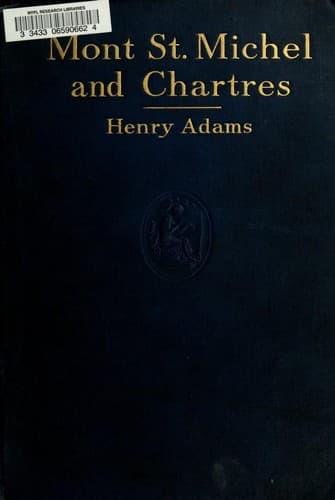
Cathédrale de Chartres; Civilization, Medieval; Mont-Saint-Michel (Abbey : France)
Abelard began it. After his first visit to Paris in 1100, he seems
to have passed several years elsewhere, while Guillaume de Champeaux
in 1108, retired from the school in the cloister of Notre Dame, and,
taking orders, established a class in a chapel near by, afterwards
famous as the Abbaye-de-Saint-Victor. The Jardin des Plantes and the
Gare d'Orleans now cover the ground where the Abbey stood, on the
banks of the Seine outside the Latin Quarter, and not a trace is
left of its site; but there William continued his course in
dialectics, until suddenly Abelard reappeared among his scholars,
and resumed his old attacks. This time Abelard could hardly call
himself a student. He was thirty years old, and long since had been
himself a teacher; he had attended William's course on dialectics
nearly ten years before, and was past master in the art; he had
nothing to learn from William in theology, for neither William nor
he was yet a theologist by profession. If Abelard went back to
school, it was certainly not to learn; but indeed, he himself made
little or no pretence of it, and told with childlike candour not
only why he went, but also how brilliantly he succeeded in his
object:--
I returned to study rhetoric in his school. Among other
controversial battles, I succeeded, by the most irrefutable
argument, in making him change, or rather ruin his doctrine of
universals. His doctrine consisted in affirming the perfect identity
of the essence in every individual of the same species, so that
according to him there was no difference in the essence but only in
the infinite variety of accidents. He then came to amend his
doctrine so as to affirm, not the identity any longer, but the
absence of distinction--the want of difference--in the essence. And
as this question of universals had always been one of the most
important questions of dialectics--so important that Porphyry,
touching on it in his Preliminaries, did not dare to take the
responsibility of cutting the knot, but said, "It is a very grave
point,"--Champeaux, who was obliged to modify his idea and then
renounce it, saw his course fall into such discredit that they
hardly let him make his dialectical lectures, as though dialectics
consisted entirely in the question of universals.
Public-domain text, read in full here on John Shaqi.
Reviews
Reviews
No reviews yet
Be the first to share your thoughts on this work.
Elsewhere in the archive
Join the Discussion
Join the discussion
Sign in to leave a comment or review.
Sign InorCreate an account