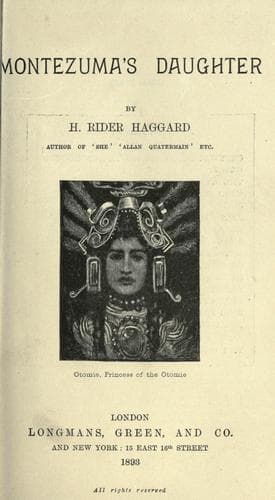
Montezuma's DaughterHaggard, H. Rider (Henry Rider)
History
Montezuma's Daughter
Haggard, H. Rider (Henry Rider)
Mexico -- History -- Conquest, 1519-1540 -- Fiction
Then taking my hand, without another word she turned and passed thence.
As will be seen, she kept her oath.
On that day and on the morrow there was fighting with the Spaniards,
who sallied out to fill up the gaps in the dykes of the causeway, a
task in which they succeeded, though with some loss. But it availed
them nothing, for so soon as their backs were turned we opened the
dykes again. It was on these days that for the first time I had
experience of war, and armed with my bow made after the English
pattern, I did good service. As it chanced, the very first arrow that I
drew was on my hated foe de Garcia, but here my common fortune pursued
me, for being out of practice, or over-anxious, I aimed too high,
though the mark was an easy one, and the shaft pierced the iron of his
casque, causing him to reel in his saddle, but doing him no further
hurt. Still this marksmanship, poor as it was, gained me great renown
among the Aztecs, who were but feeble archers, for they had never
before seen an arrow pierce through the Spanish mail. Nor would mine
have done so had I not collected the iron barbs off the crossbow bolts
of the Spaniards, and fitted them to my own shafts. I seldom found the
mail that would withstand arrows made thus, when the range was short
and the aim good.
After the first day’s fight I was appointed general over a body of
three thousand archers, and was given a banner to be borne before me
and a gorgeous captain’s dress to wear. But what pleased me better was
a chain shirt which came from the body of a Spanish cavalier. For many
years I always wore this shirt beneath my cotton mail, and it saved my
life more than once, for even bullets would not pierce the two of them.
I had taken over the command of my archers but forty-eight hours, a
scant time in which to teach them discipline whereof they had little,
though they were brave enough, when the occasion came to use them in
good earnest, and with it the night of disaster that is still known
among the Spaniards as the _noche triste_. On the afternoon before that
night a council was held in the palace at which I spoke, saying, I was
certain that the Teules thought of retreat from the city, and in the
dark, for otherwise they would not have been so eager to fill up the
canals in the causeway. To this Cuitlahua, who now that Montezuma was
dead would be emperor, though he was not yet chosen and crowned,
answered that it might well be that the Teules meditated flight, but
that they could never attempt it in the darkness, since in so doing
they must become entangled in the streets and dykes.
Public-domain text, read in full here on John Shaqi.
Reviews
Reviews
No reviews yet
Be the first to share your thoughts on this work.
Elsewhere in the archive
Join the Discussion
Join the discussion
Sign in to leave a comment or review.
Sign InorCreate an account