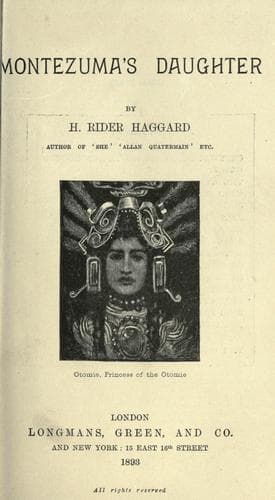
Montezuma's DaughterHaggard, H. Rider (Henry Rider)
History
Montezuma's Daughter
Haggard, H. Rider (Henry Rider)
Mexico -- History -- Conquest, 1519-1540 -- Fiction
How shall I paint the horrors that day by day were heaped upon the
doomed city? Soon all the food was gone, and men, ay, and worse still,
tender women and children, must eat such meat as swine would have
turned from, striving to keep life in them for a little longer. Grass,
the bark of trees, slugs and insects, washed down with brackish water
from the lake, these were their best food, these and the flesh of
captives offered in sacrifice. Now they began to die by hundreds and by
thousands, they died so fast that none could bury them. Where they
perished, there they lay, till at length their bodies bred a plague, a
black and horrible fever that swept off thousands more, who in turn
became the root of pestilence. For one who was killed by the Spaniards
and their allies, two were swept off by hunger and plague. Think then
what was the number of dead when not less than seventy thousand
perished beneath the sword and by fire alone. Indeed, it is said that
forty thousand died in this manner in a single day, the day before the
last of the siege.
One night I came back to the lodging where Otomie dwelt with her royal
sister Tecuichpo, the wife of Guatemoc, for now all the palaces had
been burnt down. I was starving, for I had scarcely tasted food for
forty hours, but all that my wife could set before me were three little
meal cakes, or _tortillas_, mixed with bark. She kissed me and bade me
eat them, but I discovered that she herself had touched no food that
day, so I would not till she shared them. Then I noted that she could
scarcely swallow the bitter morsels, and also that she strove to hide
tears which ran down her face.
“What is it, wife?” I asked.
Then Otomie broke out into a great and bitter crying and said:
“This, my beloved: for two days the milk has been dry in my
breast—hunger has dried it—and our babe is dead! Look, he lies dead!”
and she drew aside a cloth and showed me the tiny body.
“Hush,” I said, “he is spared much. Can we then desire that a child
should live to see such days as we have seen, and after all, to die at
last?”
“He was our son, our first-born,” she cried again. “Oh! why must we
suffer thus?”
“We must suffer, Otomie, because we are born to it. Just so much
happiness is given to us as shall save us from madness and no more. Ask
me not why, for I cannot answer you! There is no answer in my faith or
in any other.”
And then, looking on that dead babe, I wept also. Every hour in those
terrible months it was my lot to see a thousand sights more awful, and
yet this sight of a dead infant moved me the most of all of them. The
child was mine, my firstborn, its mother wept beside me, and its stiff
and tiny fingers seemed to drag at my heart strings. Seek not the
cause, for the Almighty Who gave the heart its infinite power of pain
alone can answer, and to our ears He is dumb.
Public-domain text, read in full here on John Shaqi.
Reviews
Reviews
No reviews yet
Be the first to share your thoughts on this work.
Elsewhere in the archive
Join the Discussion
Join the discussion
Sign in to leave a comment or review.
Sign InorCreate an account