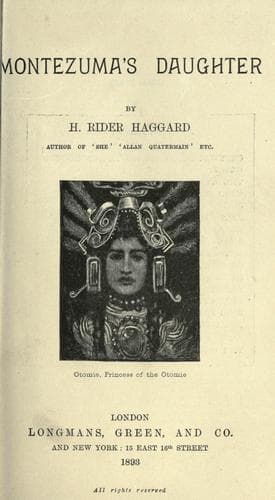
Montezuma's DaughterHaggard, H. Rider (Henry Rider)
History
Montezuma's Daughter
Haggard, H. Rider (Henry Rider)
Mexico -- History -- Conquest, 1519-1540 -- Fiction
will be glutted, but till then I triumph, ay, even when I must sink to
this butcher’s work to do it,” and suddenly he turned and left the
place.
Then weakness and suffering overcame me and I swooned away. When I
awoke it was to find that my bonds had been loosed and that I lay on
some sort of bed, while a woman bent over me, tending me with murmured
words of pity and love. The night had fallen, but there was light in
the chamber, and by it I saw that the woman was none other than Otomie,
no longer starved and wretched, but almost as lovely as before the days
of siege and hunger.
“Otomie! you here!” I gasped through my wounded lips, for with my
senses came the memory of de Garcia’s threats.
“Yes, beloved, it is I,” she murmured; “they have suffered that I nurse
you, devils though they are. Oh! that I must see you thus and yet be
helpless to avenge you,” and she burst into weeping.
“Hush,” I said, “hush. Have we food?”
“In plenty. A woman brought it from Marina.”
“Give me to eat, Otomie.”
Now for a while she fed me and the deadly sickness passed from me,
though my poor flesh burned with a hundred agonies.
“Listen, Otomie: have you seen de Garcia?”
“No, husband. Two days since I was separated from my sister Tecuichpo
and the other ladies, but I have been well treated and have seen no
Spaniard except the soldiers who led me here, telling me that you were
sick. Alas! I knew not from what cause,” and again she began to weep.
“Still some have seen you and it is reported that you are my wife.”
“It is likely enough,” she answered, “for it was known throughout the
Aztec hosts, and such secrets cannot be kept. But why have they treated
you thus? Because you fought against them?”
“Are we alone?” I asked.
“The guard is without, but there are none else in the chamber.”
“Then bend down your head and I will tell you,” and I told her all.
When I had done so she sprang up with flashing eyes and her hand
pressed upon her breast, and said:
“Oh! if I loved you before, now I love you more if that is possible,
who could suffer thus horribly and yet be faithful to the fallen and
your oath. Blessed be the day when first I looked upon your face, O my
husband, most true of men. But they who could do this—what of them?
Still it is done with and I will nurse you back to health. Surely it is
done with, or they had not suffered me to come to you?”
“Alas! Otomie, I must tell all—it is _not_ done with,” and with
faltering voice I went on with the tale, yes, and since I must, I told
her for what purpose she had been brought here. She listened without a
word, though her lips turned pale.
“Truly,” she said when I had done, “these Teules far surpass the
_pabas_ of our people, for if the priests torture and sacrifice, it is
to the gods and not for gold and secret hate. Now, husband, what is
your counsel? Surely you have some counsel.”
“I have none that I dare offer, wife,” I groaned.
Public-domain text, read in full here on John Shaqi.
Reviews
Reviews
No reviews yet
Be the first to share your thoughts on this work.
Elsewhere in the archive
Join the Discussion
Join the discussion
Sign in to leave a comment or review.
Sign InorCreate an account