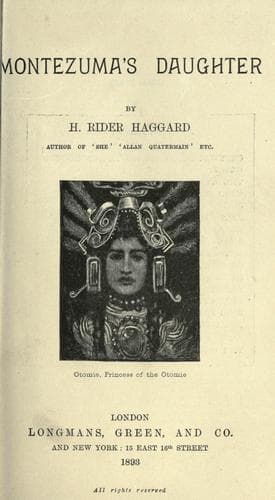
Montezuma's DaughterHaggard, H. Rider (Henry Rider)
History
Montezuma's Daughter
Haggard, H. Rider (Henry Rider)
Mexico -- History -- Conquest, 1519-1540 -- Fiction
Till nightfall the Spaniards bombarded the shattered remains of the
gates and the earthworks behind them, doing no great damage beyond the
killing of about a score of people by cannon shot and arquebuss balls.
But they attempted no assault that day. At length the darkness fell and
their fire ceased, but not so our labours. Most of the men must guard
the gates and the weak spots in the walls, and therefore the building
of the barricades was left chiefly to the women, working under my
command and that of my captains. Otomie herself took a share in the
toil, an example that was followed by every lady and indeed by every
woman in the city, and there were many of them, for the women
outnumbered the men among the Otomie, and moreover not a few of them
had been made widows on that same day.
It was a strange sight to see them in the glare of hundreds of torches
split from the resin pine that gave its name to the city, as all night
long they moved to and fro in lines, each of them staggering beneath
the weight of a basket of earth or a heavy stone, or dug with wooden
spades at the hard soil, or laboured at the pulling down of houses.
They never complained, but worked on sullenly and despairingly; no
groan or tear broke from them, no, not even from those whose husbands
and sons had been hurled that morning from the precipices of the pass.
They knew that resistance would be useless and that their doom was at
hand, but no cry arose among them of surrender to the Spaniards. Those
of them who spoke of the matter at all said with Otomie, that it was
better to die free than to live as slaves, but the most did not speak;
the old and the young, mother, wife, widow, and maid, they laboured in
silence and the children laboured at their sides.
Looking at them it came into my mind that these silent patient women
were inspired by some common and desperate purpose, that all knew of,
but which none of them chose to tell.
“Will you work so hard for your masters the Teules?” cried a man in
bitter mockery, as a file of them toiled past beneath their loads of
stone.
“Fool!” answered their leader, a young and lovely lady of rank; “do the
dead labour?”
“Nay,” said this ill jester, “but such as you are too fair for the
Teules to kill, and your years of slavery will be many. Say, how shall
you escape them?”
“Fool!” answered the lady again, “does fire die from lack of fuel only,
and must every man live till age takes him? We shall escape them thus,”
and casting down the torch she carried, she trod it into the earth with
her sandal, and went on with her load. Then I was sure that they had
some purpose, though I did not guess how desperate it was, and Otomie
would tell me nothing of this woman’s secret.
“Otomie,” I said to her that night, when we met by chance, “I have ill
news for you.”
“It must be bad indeed, husband, to be so named in such an hour,” she
answered.
“De Garcia is among our foes.”
“I knew it, husband.”
“How did you know it?”
Public-domain text, read in full here on John Shaqi.
Reviews
Reviews
No reviews yet
Be the first to share your thoughts on this work.
Elsewhere in the archive
Join the Discussion
Join the discussion
Sign in to leave a comment or review.
Sign InorCreate an account