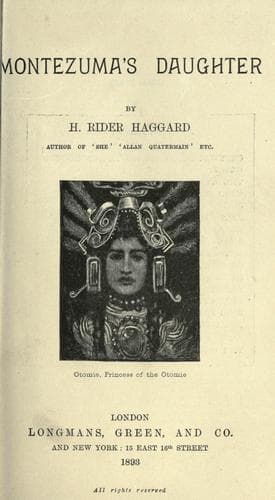
Montezuma's DaughterHaggard, H. Rider (Henry Rider)
History
Montezuma's Daughter
Haggard, H. Rider (Henry Rider)
Mexico -- History -- Conquest, 1519-1540 -- Fiction
Even now the burden of that chant with the vision of those who sang it
sometimes haunts my sleep at night, but I will not write it here. Let
him who reads imagine all that is most cruel in the heart of man, and
every terror of the evillest dream, adding to these some horror-ridden
tale of murder, ghosts, and inhuman vengeance; then, if he can, let him
shape the whole in words and, as in a glass darkly, perchance he may
mirror the spirit of that last ancient song of the women of the Otomie,
with its sobs, its cries of triumph, and its death wailings.
Ever as they sang, step by step they drew backwards, and with them went
the leaders of each company, their eyes fixed upon the statues of their
gods. Now they were but a segment of a circle, for they did not advance
towards the temple; backward and outward they went with a slow and
solemn tramp. There was but one line of them now, for those in the
second ring filled the gaps in the first as it widened; still they drew
on till at length they stood on the sheer edge of the platform. Then
the priests and the women leaders took their place among them and for a
moment there was silence, until at a signal one and all they bent them
backwards. Standing thus, their long hair waving on the wind, the light
of burning houses flaring upon their breasts and in their maddened
eyes, they burst into the cry of:
“_Save us, Huitzel! receive us, lord god, our home!_”
Thrice they cried it, each time more shrilly than before, then suddenly
they were _gone_, the women of the Otomie were no more!
With their own self-slaughter they had consummated the last celebration
of the rites of sacrifice that ever shall be held in the City of Pines.
The devil gods were dead and their worshippers with them.
A low murmur ran round the lips of the men who watched, then one cried,
and his voice rang strangely in the sudden silence: “May our wives, the
women of the Otomie, rest softly in the Houses of the Sun, for of a
surety they teach us how to die.”
“Ay,” I answered, “but not thus. Let women do self-murder, our foes
have swords for the hearts of men.”
I turned to go, and before me stood Otomie.
“What has befallen?” she said. “Where are my sisters? Oh! surely I have
dreamed an evil dream. I dreamed that the gods of my forefathers were
strong once more, and that once more they drank the blood of men.”
“Your ill dream has a worse awakening, Otomie,” I answered. “The gods
of hell are still strong indeed in this accursed land, and they have
taken your sisters into their keeping.”
“Is it so?” she said softly, “yet in my dream it seemed to me that this
was their last strength ere they sink into death unending. Look
yonder!” and she pointed toward the snowy crest of the volcan Xaca.
Public-domain text, read in full here on John Shaqi.
Reviews
Reviews
No reviews yet
Be the first to share your thoughts on this work.
Elsewhere in the archive
Join the Discussion
Join the discussion
Sign in to leave a comment or review.
Sign InorCreate an account