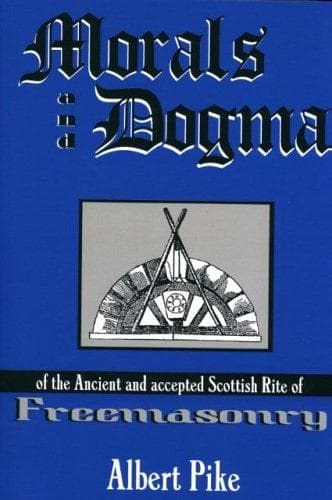
Morals and Dogma of the Ancient and Accepted Scottish Rite of FreemasonryPike, Albert
Religion
Morals and Dogma of the Ancient and Accepted Scottish Rite of Freemasonry
Pike, Albert
Freemasons
A few rudimentary lessons in architecture, a few universally admitted
maxims of morality, a few unimportant traditions, whose real meaning is
unknown or misunderstood, will no longer satisfy the earnest inquirer
after Masonic truth. Let whoso is content with these, seek to climb no
higher. He who desires to understand the harmonious and beautiful
proportions of Freemasonry must read, study, reflect, digest, and
discriminate. The true Mason is an ardent seeker after knowledge; and he
knows that both books and the antique symbols of Masonry are vessels
which come down to us full-freighted with the intellectual riches of the
Past; and that in the lading of these argosies is much that sheds light
on the history of Masonry, and proves its claim to be acknowledged the
benefactor of mankind, born in the very cradle of the race.
Knowledge is the most genuine and real of human treasures; for it is
Light, as Ignorance is Darkness. It is the _development_ of the human
soul, and its acquisition the _growth_ of the soul, which at the birth
of man knows nothing, and therefore, in one sense, may be said to _be_
nothing. It is the seed, which has in it the _power_ to grow, to
acquire, and by acquiring to be developed, as the seed is developed into
the shoot, the plant, the tree. "We need not pause at the common
argument that by learning man excelleth man, in that wherein man
excelleth beasts; that by learning man ascendeth to the heavens and
their motions, where in body he cannot come, and the like. Let us rather
regard the dignity and excellency of knowledge and learning in that
whereunto man's nature doth most aspire, which is immortality or
continuance. For to this tendeth generation, and raising of Houses and
Families; to this buildings, foundations, and monuments; to this tendeth
the desire of memory, fame, and celebration, and in effect the strength
of all other human desires." That our influences shall survive us, and
be living forces when we are in our graves; and not merely that our
names shall be remembered; but rather that our works shall be read, our
acts spoken of, our names recollected and mentioned when we are dead, as
evidences that those influences live and rule, sway and control some
portion of mankind and of the world,--this is the aspiration of the
human soul. "We see then how far the monuments of genius and learning
are more durable than monuments of power or of the hands. For have not
the verses of Homer continued twenty-five hundred years or more, without
the loss of a syllable or letter, during which time infinite palaces,
temples, castles, cities, have decayed and been demolished? It is not
possible to have the true pictures or statues of Cyrus, Alexander,
Caesar, no, nor of the Kings or great personages of much later years;
for the originals cannot last, and the copies cannot but lose of the
life and truth. But the images of men's genius and knowledge remain in
books, exempted from the wrong of time, and capable of perpetual
Public-domain text, read in full here on John Shaqi.
Reviews
Reviews
No reviews yet
Be the first to share your thoughts on this work.
Elsewhere in the archive
Join the Discussion
Join the discussion
Sign in to leave a comment or review.
Sign InorCreate an account