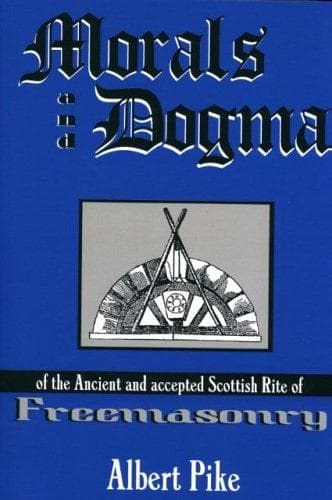
Morals and Dogma of the Ancient and Accepted Scottish Rite of FreemasonryPike, Albert
Religion
Morals and Dogma of the Ancient and Accepted Scottish Rite of Freemasonry
Pike, Albert
Freemasons
Secrecy is indispensable in a Mason of whatever Degree. It is the first
and almost the only lesson taught to the Entered Apprentice. The
obligations which we have each assumed toward every Mason that lives,
requiring of us the performance of the most serious and onerous duties
toward those personally unknown to us until they demand our aid,--duties
that must be performed, even at the risk of life, or our solemn oaths be
broken and violated, and we be branded as false Masons and faithless
men, teach us how profound a folly it would be to betray our secrets to
those who, bound to us by no tie of common obligation, might, by
obtaining them, call on us in their extremity, when the urgency of the
occasion should allow us no time for inquiry, and the peremptory mandate
of our obligation compel us to do a brother's duty to a base impostor.
The secrets of our brother, when communicated to us, must be sacred, if
they be such as the law of our country warrants us to keep. We are
required to keep none other, when the law that we are called on to obey
is indeed a law, by having emanated from the only source of power, the
People. Edicts which emanate from the mere arbitrary will of a despotic
power, contrary to the law of God or the Great Law of Nature,
destructive of the inherent rights of man, violative of the right of
free thought, free speech, free conscience, it is lawful to rebel
against and strive to abrogate.
For obedience to the Law does not mean submission to tyranny; nor that,
by a profligate sacrifice of every noble feeling, we should offer to
despotism the homage of adulation. As every new victim falls, we _may_
lift our voice in still louder flattery. We _may_ fall at the proud
feet, we _may_ beg, as a boon, the honor of kissing that bloody hand
which has been lifted against the helpless. We may do more: we may bring
the altar and the sacrifice, and implore the God not to ascend too soon
to Heaven. This we may do, for this we have the sad remembrance that
beings of a human form and soul have done. But this is all we can do. We
can constrain our tongues to be false, our features to bend themselves
to the semblance of that passionate adoration which we wish to express,
our knees to fall prostrate; but our heart we cannot constrain. There
virtue must still have a voice which is not to be drowned by hymns and
acclamations; there the crimes which we laud as virtues, are crimes
still, and he whom we have made a God is the most contemptible of
mankind; if, indeed, we do not feel, perhaps, that we are ourselves
still more contemptible.
Public-domain text, read in full here on John Shaqi.
Reviews
Reviews
No reviews yet
Be the first to share your thoughts on this work.
Elsewhere in the archive
Join the Discussion
Join the discussion
Sign in to leave a comment or review.
Sign InorCreate an account