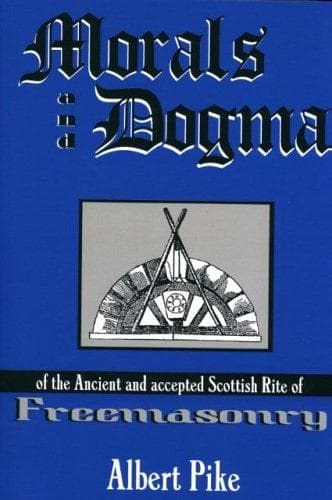
Morals and Dogma of the Ancient and Accepted Scottish Rite of FreemasonryPike, Albert
Religion
Morals and Dogma of the Ancient and Accepted Scottish Rite of Freemasonry
Pike, Albert
Freemasons
What nerves the arm of toil? If man minded himself alone, he would fling
down the spade and axe, and rush to the desert; or roam through the
world as a wilderness, and make that world a desert. His home, which he
sees not, perhaps, but once or twice in a day, is the invisible bond of
the world. It is the good, strong, and noble faith that men have in each
other, which gives the loftiest character to business, trade, and
commerce. Fraud occurs in the rush of business; but it is the exception.
Honesty is the rule; and all the frauds in the world cannot tear the
great bond of human confidence. If they could, commerce would furl its
sails on every sea, and all the cities of the world would crumble into
ruins. The bare character of a man on the other side of the world, whom
you never saw, whom you never will see, you hold good for a bond of
thousands. The most striking feature of the political state is not
governments, nor constitutions, nor laws, nor enactments, nor the
judicial power, nor the police; but the universal will of the people to
be governed by the common weal. Take off that restraint, and no
government on earth could stand for an hour.
Of the many teachings of Masonry, one of the most valuable is, that we
should not depreciate this life. It does not hold, that when we reflect
on the destiny that awaits man on earth, we ought to bedew his cradle
with our tears; but, like the Hebrews, it hails the birth of a child
with joy, and holds that his birthday should be a festival.
It has no sympathy with those who profess to have proved this life, and
found it little worth; who have deliberately made up their minds that it
is far more miserable than happy; because its employments are tedious,
and their schemes often baffled, their friendships broken, or their
friends dead, its pleasures palled, and its honors faded, and its paths
beaten, familiar, and dull.
Masonry deems it no mark of great piety toward God to disparage, if not
despise, the state that He has ordained for us. It does not absurdly set
up the claims of another world, not in comparison merely, but in
competition, with the claims of this. It looks upon both as parts of one
system. It holds that a man may make the best of this world and of
another at the same time. It does not teach its initiates to think
better of other works and dispensations of God, by thinking meanly of
these. It does not look upon life as so much time lost; nor regard its
employments as trifles unworthy of immortal beings; nor tell its
followers to fold their arms, as if in disdain of their state and
species; but it looks soberly and cheerfully upon the world, as a
theatre of worthy action, of exalted usefulness, and of rational and
innocent enjoyment.
Public-domain text, read in full here on John Shaqi.
Reviews
Reviews
No reviews yet
Be the first to share your thoughts on this work.
Elsewhere in the archive
Join the Discussion
Join the discussion
Sign in to leave a comment or review.
Sign InorCreate an account