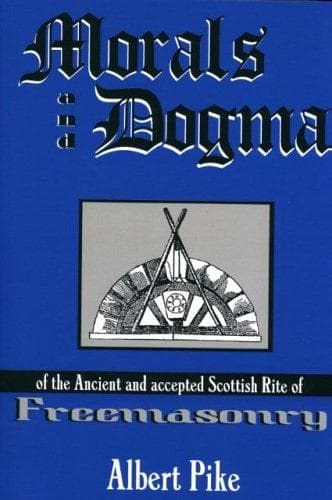
Morals and Dogma of the Ancient and Accepted Scottish Rite of FreemasonryPike, Albert
Religion
Morals and Dogma of the Ancient and Accepted Scottish Rite of Freemasonry
Pike, Albert
Freemasons
It recognizes it as a truth, that necessity, as well as abstract right
and ideal justice, must have its part in the making of laws, the
administration of affairs, and the regulation of relations in society.
It sees, indeed, that necessity rules in all the affairs of man. It
knows that where any man, or any number or race of men, are so imbecile
of intellect, so degraded, so incapable of self-control, so inferior in
the scale of humanity, as to be unfit to be intrusted with the highest
prerogatives of citizenship, the great law of necessity, for the peace
and safety of the community and country, requires them to remain under
the control of those of larger intellect and superior wisdom. It trusts
and believes that God will, in his own good time, work out his own great
and wise purposes; and it is willing to wait, where it does not see its
own way clear to some certain good.
It hopes and longs for the day when all the races of men, even the
lowest, will be elevated, and become fitted for political freedom; when,
like all other evils that afflict the earth, pauperism, and bondage or
abject dependence, shall cease and disappear. But it does not preach
revolution to those who are fond of kings, nor rebellion that can end
only in disaster and defeat, or in substituting one tyrant for another,
or a multitude of despots for one.
Wherever a people is fit to be free and to govern itself, and generously
strives to be so, there go all its sympathies. It detests the tyrant,
the lawless oppressor, the military usurper, and him who abuses a lawful
power. It frowns upon cruelty, and a wanton disregard of the rights of
humanity. It abhors the selfish employer, and exerts its influence to
lighten the burdens which want and dependence impose upon the workman,
and to foster that humanity and kindness which man owes to even the
poorest and most unfortunate brother.
It can never be employed, in any country under Heaven, to teach a
toleration for cruelty, to weaken moral hatred for guilt, or to deprave
and brutalize the human mind. The dread of punishment will never make a
Mason an accomplice in so corrupting his countrymen, and a teacher of
depravity and barbarity. If anywhere, as has heretofore happened, a
tyrant should send a satirist on his tyranny to be convicted and
punished as a libeller, in a court of justice, a Mason, if a juror in
such a case, though in sight of the scaffold streaming with the blood of
the innocent, and within hearing of the clash of the bayonets meant to
overawe the court, would rescue the intrepid satirist from the tyrant's
fangs, and send his officers out from the court with defeat and
disgrace.
Public-domain text, read in full here on John Shaqi.
Reviews
Reviews
No reviews yet
Be the first to share your thoughts on this work.
Elsewhere in the archive
Join the Discussion
Join the discussion
Sign in to leave a comment or review.
Sign InorCreate an account