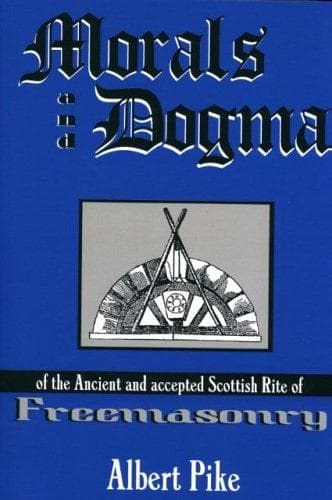
Morals and Dogma of the Ancient and Accepted Scottish Rite of FreemasonryPike, Albert
Religion
Morals and Dogma of the Ancient and Accepted Scottish Rite of Freemasonry
Pike, Albert
Freemasons
The good Mason does the good thing which comes in his way, and because
it comes in his way; from a love of duty, and not merely because a law,
enacted by man or God, commands his _will_ to do it. He is true to his
mind, his conscience, heart, and soul, and feels small temptation to do
to others what he would not wish to receive from them. He will deny
himself for the sake of his brother near at hand. His _desire_ attracts
in the line of his _duty_, both being in conjunction. Not in vain does
the poor or the oppressed look up to him. You find such men in all
Christian sects, Protestant and Catholic, in all the great religious
parties of the civilized world, among Buddhists, Mahometans, and Jews.
They are kind fathers, generous citizens, unimpeachable in their
business, beautiful in their daily lives. You see their Masonry in their
work and in their play. It appears in all the forms of their activity,
individual, domestic, social, ecclesiastical, or political. True Masonry
within must be morality without. It must become _eminent_ morality,
which is philanthropy. The true Mason loves not only his kindred and his
country, but all mankind; not only the good, but also the evil, among
his brethren. He has more goodness than the channels of his daily life
will hold. It runs over the banks, to water and to feed a thousand
thirsty plants. Not content with the duty that lies along his track, he
goes out to seek it; not only _willing_, he has a salient _longing_ to
do good, to spread his truth, his justice, his generosity, his Masonry
over all the world. His daily life is a profession of his Masonry,
published in perpetual good-will to men. He _can_ not be a persecutor.
Not more naturally does the beaver build or the mocking-bird sing his
own wild, gushing melody, than the true Mason lives in this beautiful
outward life. So from the perennial spring swells forth the stream, to
quicken the meadow with new access of green, and perfect beauty bursting
into bloom. Thus Masonry does the work it was meant to do. The Mason
does not sigh and weep, and make grimaces. He lives right on. If his
life is, as whose is not, marked with errors, and with sins, he ploughs
over the barren spot with his remorse, sows with new seed, and the old
desert blossoms like a rose. He is not confined to set forms of thought,
of action, or of feeling. He accepts what his mind regards as true, what
his conscience decides is right, what his heart deems generous and
noble; and all else he puts far from him. Though the ancient and the
honorable of the Earth bid him bow down to them, his stubborn knees bend
only at the bidding of his manly soul. His Masonry is his freedom before
God, not his bondage unto men. His mind acts after the universal law of
the intellect, his conscience according to the universal moral law, his
affections and his soul after the universal law of each, and so he is
strong with the strength of God, in this four-fold way communicating
with Him.
Public-domain text, read in full here on John Shaqi.
Reviews
Reviews
No reviews yet
Be the first to share your thoughts on this work.
Elsewhere in the archive
Join the Discussion
Join the discussion
Sign in to leave a comment or review.
Sign InorCreate an account