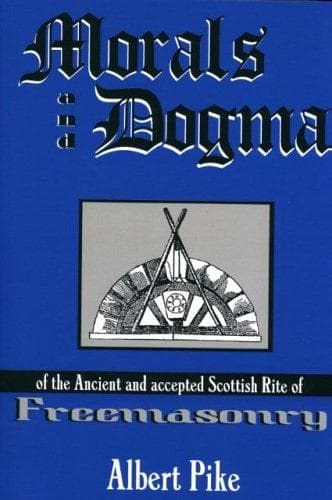
Morals and Dogma of the Ancient and Accepted Scottish Rite of FreemasonryPike, Albert
Religion
Morals and Dogma of the Ancient and Accepted Scottish Rite of Freemasonry
Pike, Albert
Freemasons
"Honor thy father and mother. Never forget the benefits thou hast
received. Learn while thou art young. Be submissive to the laws of
thy country. Seek the company of virtuous men. Speak not of God but
with respect. Live on good terms with thy fellow-citizens. Remain
in thy proper place. Speak ill of no one. Mock at the bodily
infirmities of none. Pursue not unrelentingly a conquered enemy.
Strive to acquire a good reputation. Take counsel with wise men.
The more one learns, the more he acquires the faculty of learning.
Knowledge is the most permanent wealth. As well be dumb as
ignorant. The true use of knowledge is to distinguish good from
evil. Be not a subject of shame to thy parents. What one learns in
youth endures like the engraving upon a rock. He is wise who knows
himself. Let thy books be thy best friends. When thou attainest an
hundred years, cease to learn. Wisdom is solidly planted, even on
the shifting ocean. Deceive no one, not even thine enemy. Wisdom is
a treasure that everywhere commands its value. Speak mildly, even
to the poor. It is sweeter to forgive than to take vengeance.
Gaming and quarrels lead to misery. There is no true merit without
the practice of virtue. To honor our mother is the most fitting
homage we can pay the Divinity. There is no tranquil sleep without
a clear conscience. He badly understands his interest who breaks
his word."
Twenty-four centuries ago these were the Chinese Ethics:
"The Philosopher [Confucius] said, 'SAN! my doctrine is simple, and
easy to be understood.' THSENG-TSEU replied, 'that is certain.' The
Philosopher having gone out, the disciples asked what their master
had meant to say. THSENG-TSEU responded, 'The doctrine of our
Master consists solely in being upright of heart, and loving our
neighbor as we love ourself.'"
About a Century later, the Hebrew law said,
"If any man hate his neighbor ... then shall ye do unto him, as he
had thought to do unto his brother ... Better is a neighbor that
is near, than a brother afar off ... Thou shalt love thy neighbor
as thyself."
In the same fifth century before Christ, SOCRATES the Grecian said,
"Thou shalt love thy neighbor as thyself."
Three generations earlier, ZOROASTER had said to the Persians:
"Offer up thy grateful prayers to the Lord, the most just and pure
Ormuzd, the supreme and adorable God, who thus declared to his
Prophet Zerdusht: 'Hold it not meet to do unto others what thou
wouldst not desire done unto thyself; do that unto the people,
which, when done to thyself, is not disagreeable unto thee.'"
Public-domain text, read in full here on John Shaqi.
Reviews
Reviews
No reviews yet
Be the first to share your thoughts on this work.
Elsewhere in the archive
Join the Discussion
Join the discussion
Sign in to leave a comment or review.
Sign InorCreate an account