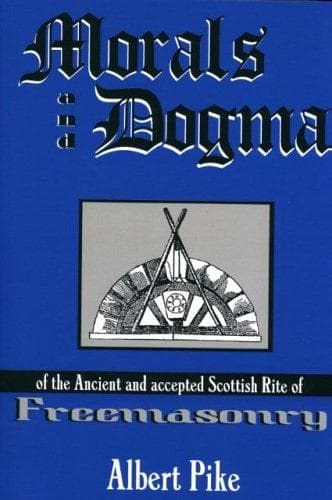
Morals and Dogma of the Ancient and Accepted Scottish Rite of FreemasonryPike, Albert
Religion
Morals and Dogma of the Ancient and Accepted Scottish Rite of Freemasonry
Pike, Albert
Freemasons
We all not only have better intimations, but are capable of better
things than we know. The pressure of some great emergency would develop
in us powers, beyond the worldly bias of our spirits; and Heaven so
deals with us, from time to time, as to call forth those better things.
There is hardly a family in the world so selfish, but that, if one in it
were doomed to die--one, to be selected by the others,--it would be
utterly impossible for its members, parents and children, to choose out
that victim; but that each would say, "I will die; but I cannot choose."
And in how many, if that dire extremity had come, would not one and
another step forth, freed from the vile meshes of ordinary selfishness,
and say, like the Roman father and son, "Let the blow fall on me!" There
are greater and better things in us all, than the world takes account
of, or than _we_ take note of; if we would but find them out. And it is
one part of our Masonic culture to _find_ these traits of power and
sublime devotion, to revive these faded impressions of generosity and
self-sacrifice, the almost squandered bequests of God's love and
kindness to our souls; and to induce us to yield ourselves to their
guidance and control.
Upon all conditions of men presses down one impartial law. To all
situations, to all fortunes, high or low, the _mind_ gives their
character. They are, in effect, not what they are in themselves, but
what they are to the feeling of their possessors. The King may be mean,
degraded, miserable; the slave of ambition, fear, voluptuousness, and
every low passion. The Peasant may be the real Monarch, the moral master
of his fate, a free and lofty being, more than a Prince in happiness,
more than a King in honor.
Man is no bubble upon the sea of his fortunes, helpless and
irresponsible upon the tide of events. Out of the same circumstances,
different men bring totally different results. The same difficulty,
distress, poverty, or misfortune, that breaks down one man, builds up
another and makes him strong. It is the very attribute and glory of a
man, that he can bend the circumstances of his condition to the
intellectual and moral purposes of his nature, and it is the power and
mastery of his will that chiefly distinguish him from the brute.
The faculty of moral will, developed in the child, is a new element of
his nature. It is a new power brought upon the scene, and a ruling
power, delegated from Heaven. Never was a human being sunk so low that
he had not, by God's gift, the power to rise. Because God commands him
to rise, it is certain that he _can_ rise. Every man has the power, and
should use it, to make all situations, trials, and temptations
instruments to promote his virtue and happiness; and is so far from
being the creature of circumstances, that _he_ creates and controls
_them_, making them to be all that they are, of evil or of good, to him
as a moral being.
Public-domain text, read in full here on John Shaqi.
Reviews
Reviews
No reviews yet
Be the first to share your thoughts on this work.
Elsewhere in the archive
Join the Discussion
Join the discussion
Sign in to leave a comment or review.
Sign InorCreate an account