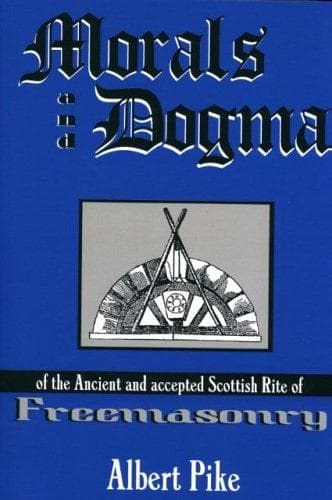
Morals and Dogma of the Ancient and Accepted Scottish Rite of FreemasonryPike, Albert
Religion
Morals and Dogma of the Ancient and Accepted Scottish Rite of Freemasonry
Pike, Albert
Freemasons
A Mason's great business with life is to read the book of its teaching;
to find that life is not the doing of drudgeries, but the hearing of
oracles. The old mythology is but a leaf in that book; for it peopled
the world with spiritual natures; and science, many-leaved, still
spreads before us the same tale of wonder.
We shall be just as happy hereafter, as we are pure and upright, and no
more, just as happy as our character prepares us to be, and no more. Our
moral, like our mental character, is not formed in a moment; it is the
habit of our minds; the result of many thoughts and feelings and
efforts, bound together by many natural and strong ties. The great law
of Retribution is, that all coming experience is to be affected by every
present feeling; every future moment of being must answer for every
present moment; one moment, sacrificed to vice, or lost to improvement,
is _forever_ sacrificed and lost; an hour's delay to enter the right
path, is to put us back so far, in the everlasting pursuit of happiness;
and every sin, even of the best men, is to be thus answered for, if not
according to the full measure of its ill-desert, yet according to a rule
of unbending rectitude and impartiality.
The law of retribution presses upon every man, whether he thinks of it
or not. It pursues him through all the courses of life, with a step that
never falters nor tires, and with an eye that never sleeps. If it were
not so, God's government would not be impartial; there would be no
discrimination; no moral dominion; no light shed upon the mysteries of
Providence.
Whatsoever a man soweth, that, and not something else, shall he reap.
That which we are doing, good or evil, grave or gay, that which we do
to-day and shall do to-morrow; each thought, each feeling, each action,
each event; every passing hour, every breathing moment; all are
contributing to form the character, according to which we are to be
judged. Every particle of influence that goes to form that
aggregate,--our character,--will, in that future scrutiny, be sifted out
from the mass; and, particle by particle, with ages perhaps intervening,
fall a distinct contribution to the sum of our joys or woes. Thus every
idle word and idle hour will give answer in the judgment.
Public-domain text, read in full here on John Shaqi.
Reviews
Reviews
No reviews yet
Be the first to share your thoughts on this work.
Elsewhere in the archive
Join the Discussion
Join the discussion
Sign in to leave a comment or review.
Sign InorCreate an account