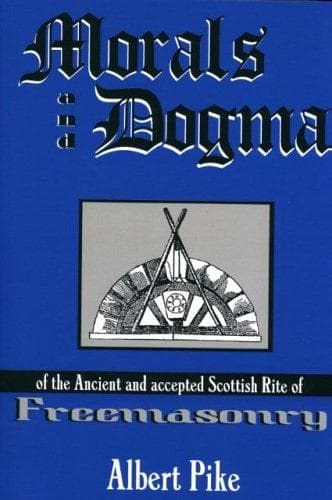
Morals and Dogma of the Ancient and Accepted Scottish Rite of FreemasonryPike, Albert
Religion
Morals and Dogma of the Ancient and Accepted Scottish Rite of Freemasonry
Pike, Albert
Freemasons
When despotism and superstition, twin-powers of evil and darkness,
reigned everywhere and seemed invincible and immortal, it invented, to
avoid persecution, the mysteries, that is to say, the allegory, the
symbol, and the emblem, and transmitted its doctrines by the secret mode
of initiation. Now, retaining its ancient symbols, and in part its
ancient ceremonies, it displays in every civilized country its banner,
on which in letters of living light its great principles are written;
and it smiles at the puny efforts of kings and popes to crush it out by
excommunication and interdiction.
Man's views in regard to God, will contain only so much positive truth
as the human mind is capable of receiving; whether that truth is
attained by the exercise of reason, or communicated by revelation. It
must necessarily be both limited and alloyed, to bring it within the
competence of finite human intelligence. Being finite, we can form no
correct or adequate idea of the Infinite; being material, we can form no
clear conception of the Spiritual. We do believe in and know the
infinity of Space and Time, and the spirituality of the Soul; but the
_idea_ of that infinity and spirituality eludes us. Even Omnipotence
cannot infuse infinite conceptions into finite minds; nor can God,
without first entirely changing the conditions of our being, pour a
complete and full knowledge of His own nature and attributes into the
narrow capacity of a human soul. Human intelligence could not grasp it,
nor human language express it. The visible is, necessarily, the measure
of the invisible.
The consciousness of the individual reveals _itself_ alone. His
knowledge cannot pass beyond the limits of his own being. His
conceptions of other things and other beings _are only his conceptions_.
They are not those things or beings themselves. The living principle of
a living Universe must be INFINITE; while all _our_ ideas and
conceptions are _finite_, and applicable only to finite beings.
The Deity is thus not an object of _knowledge_, but of _faith_; not to
be approached by the _understanding_, but by the _moral sense_; not to
be _conceived_, but to be _felt_. All attempts to embrace the Infinite
in the conception of the Finite are, and must be only accommodations to
the frailty of man. Shrouded from human comprehension in an obscurity
from which a chastened imagination is awed back, and Thought retreats in
conscious weakness, the Divine Nature is a theme on which man is little
entitled to dogmatize. Here the philosophic Intellect becomes most
painfully aware of its own insufficiency.
Public-domain text, read in full here on John Shaqi.
Reviews
Reviews
No reviews yet
Be the first to share your thoughts on this work.
Elsewhere in the archive
Join the Discussion
Join the discussion
Sign in to leave a comment or review.
Sign InorCreate an account