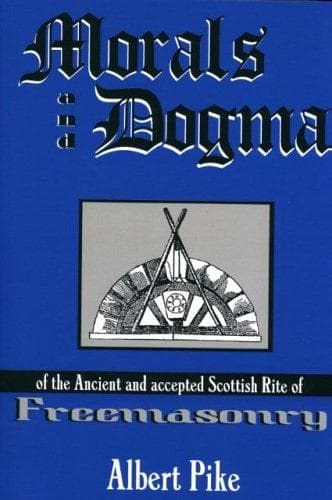
Morals and Dogma of the Ancient and Accepted Scottish Rite of FreemasonryPike, Albert
Religion
Morals and Dogma of the Ancient and Accepted Scottish Rite of Freemasonry
Pike, Albert
Freemasons
For every man's conception of God must vary with his mental cultivation
and mental powers. If any one contents himself with any _lower_ image
than his intellect is capable of grasping, then he contents himself with
that which is false _to him_, as well as false _in fact_. If lower than
he can reach, he must needs _feel_ it to be false. And if we, of the
nineteenth century after Christ, adopt the conceptions of the nineteenth
century before Him; if _our_ conceptions of God are those of the
ignorant, narrow-minded, and vindictive Israelite; then we think worse
of God, and have a lower, meaner, and more limited view of His nature,
than the faculties which He has bestowed are capable of grasping. The
highest view we can form is nearest to the truth. If we acquiesce in any
lower one, we acquiesce in an untruth. We feel that it is an affront and
an indignity to Him, to conceive of Him as cruel, short-sighted,
capricious and unjust; as a jealous, an angry, a vindictive Being.
When we examine our conceptions of His character, if we can conceive of
a loftier, nobler, higher, more beneficent, glorious, and magnificent
character, then this latter is to us the true conception of Deity; _for
nothing can be imagined more excellent than He_.
Religion, to obtain currency and influence with the great mass of
mankind, must needs be alloyed with such an amount of error as to place
it far below the standard attainable by the higher human capacities. A
religion as pure as the loftiest and most cultivated human reason could
discern, would not be comprehended by, or effective over, the less
educated portion of mankind. What is Truth to the philosopher, would not
be Truth, nor have the effect of Truth, to the peasant. The religion of
the many must necessarily be more incorrect than that of the refined and
reflective few, not so much in its essence as in its forms, not so much
in the spiritual idea which lies latent at the bottom of it, as in the
symbols and dogmas in which that idea is embodied. The truest religion
would, in many points, not be comprehended by the ignorant, nor
consolatory to them, nor guiding and supporting for them. The doctrines
of the Bible are often not clothed in the language of strict truth, but
in that which was fittest to convey to a rude and ignorant people the
practical essentials of the doctrine. A perfectly pure faith, free from
all extraneous admixtures, a system of noble theism and lofty morality,
would find too little preparation for it in the common mind and heart,
to admit of prompt reception by the masses of mankind; and Truth might
not have reached us, if it had not borrowed the wings of Error.
Public-domain text, read in full here on John Shaqi.
Reviews
Reviews
No reviews yet
Be the first to share your thoughts on this work.
Elsewhere in the archive
Join the Discussion
Join the discussion
Sign in to leave a comment or review.
Sign InorCreate an account