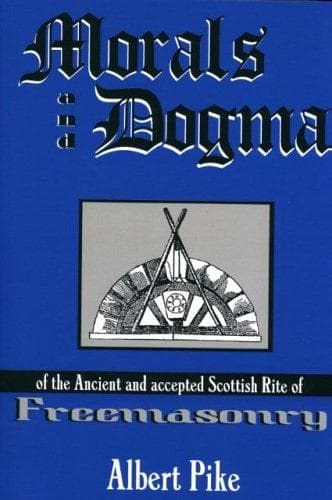
Morals and Dogma of the Ancient and Accepted Scottish Rite of FreemasonryPike, Albert
Religion
Morals and Dogma of the Ancient and Accepted Scottish Rite of Freemasonry
Pike, Albert
Freemasons
The symbolic mountain Meru was ascended by Seven steps or stages; and
all the pyramids and artificial tumuli and hillocks thrown up in flat
countries were imitations of this fabulous and mystic mountain, for
purposes of worship. These were the "High Places" so often mentioned in
the Hebrew books, on which the idolaters sacrificed to foreign gods.
The pyramids were sometimes square, and sometimes round. The sacred
Babylonian tower [[Hebrew: מגדל], Magdol], dedicated to the great Father
Bal, was an artificial hill, of pyramidal shape, and Seven stages, built
of brick, and each stage of a different color, representing the Seven
planetary spheres by the appropriate color of each planet. Meru itself
was said to be a single mountain, terminating in three peaks, and thus a
symbol of the Trimurti. The great Pagoda at Tanjore was of six stories,
surmounted by a temple as the seventh, and on this three spires or
towers. An ancient pagoda at Deogur was surmounted by a tower,
sustaining the mystic egg and a trident. Herodotus tells us that the
Temple of Bal at Babylon was a tower composed of Seven towers, resting
on an eighth that served as basis, and successively diminishing in size
from the bottom to the top; and Strabo tells us it was a pyramid.
Faber thinks that the Mithriac _ladder_ was really a pyramid with Seven
stages, each provided with a narrow door or aperture, through each of
which doors the aspirant passed, to reach the summit, and then descended
through similar doors on the opposite side of the pyramid; the ascent
and descent of the Soul being thus represented.
Each Mithriac cave and all the most ancient temples were intended to
symbolize the Universe, which itself was habitually called the Temple
and habitation of Deity. Every temple was the world in miniature; and
so the whole world was one grand temple. The most ancient temples were
roofless; and therefore the Persians, Celts, and Scythians strongly
disliked artificial covered edifices. Cicero says that Xerxes burned the
Grecian temples, on the express ground that the whole world was the
Magnificent Temple and Habitation of the Supreme Deity. Macrobius says
that the entire Universe was judiciously deemed by many the Temple of
God. Plato pronounced the real Temple of the Deity to be the world; and
Heraclitus declared that the Universe, variegated with animals and
plants and stars was the only genuine Temple of the Divinity.
Public-domain text, read in full here on John Shaqi.
Reviews
Reviews
No reviews yet
Be the first to share your thoughts on this work.
Elsewhere in the archive
Join the Discussion
Join the discussion
Sign in to leave a comment or review.
Sign InorCreate an account