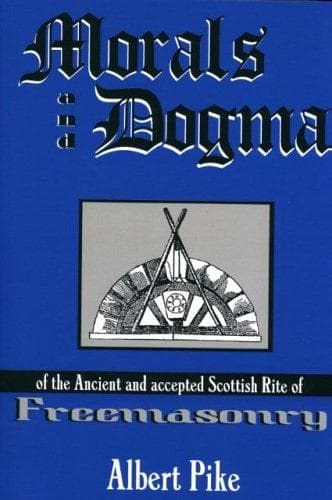
Morals and Dogma of the Ancient and Accepted Scottish Rite of FreemasonryPike, Albert
Religion
Morals and Dogma of the Ancient and Accepted Scottish Rite of Freemasonry
Pike, Albert
Freemasons
At the time when John the Baptist made his appearance in the desert,
near the shores of the Dead Sea, all the old philosophical and religious
systems were approximating toward each other. A general lassitude
inclined the minds of all toward the quietude of that amalgamation of
doctrines for which the expeditions of Alexander and the more peaceful
occurrences that followed, with the establishment in Asia and Africa of
many Grecian dynasties and a great number of Grecian colonies, had
prepared the way. After the intermingling of different nations, which
resulted from the wars of Alexander in three-quarters of the globe, the
doctrines of Greece, of Egypt, of Persia, and of India, met and
intermingled everywhere. All the barriers that had formerly kept the
nations apart, were thrown down; and while the People of the West
readily connected their faith with those of the East, those of the
Orient hastened to learn the traditions of Rome and the legends of
Athens. While the Philosophers of Greece, all (except the disciples of
Epicurus) more or less Platonists, seized eagerly upon the beliefs and
doctrines of the East,--the Jews and Egyptians, before then the most
exclusive of all peoples, yielded to that eclecticism which prevailed
among their masters, the Greeks and Romans.
Under the same influences of toleration, even those who embraced
Christianity, mingled together the old and the new, Christianity and
Philosophy, the Apostolic teachings and the traditions of Mythology. The
man of intellect, devotee of one system, rarely displaces it with
another in all its purity. The people take such a creed as is offered
them. Accordingly, the distinction between the esoteric and the exoteric
doctrine, immemorial in other creeds, easily gained a foothold among
many of the Christians; and it was held by a vast number, even during
the preaching of Paul, that the writings of the Apostles were
incomplete; that they contained only the germs of another doctrine,
which must receive from the hands of philosophy, not only the systematic
arrangement which was wanting, but all the development which lay
concealed therein. The writings of the Apostles, they said, in
addressing themselves to mankind in general, enunciated only the
articles of the vulgar faith; but transmitted the mysteries of knowledge
to superior minds, to the Elect,--mysteries handed down from generation
to generation in esoteric traditions; and to this science of the
mysteries they gave the name of [[Greek: Γνώσις] Gnōsis].
The Gnostics derived their leading doctrines and ideas from Plato and
Philo, the Zend-avesta and the Kabalah, and the Sacred books of India
and Egypt; and thus introduced into the bosom of Christianity the
cosmological and theosophical speculations, which had formed the larger
portion of the ancient religions of the Orient, joined to those of the
Egyptian, Greek, and Jewish doctrines, which the Neo-Platonists had
equally adopted in the Occident.
Public-domain text, read in full here on John Shaqi.
Reviews
Reviews
No reviews yet
Be the first to share your thoughts on this work.
Elsewhere in the archive
Join the Discussion
Join the discussion
Sign in to leave a comment or review.
Sign InorCreate an account