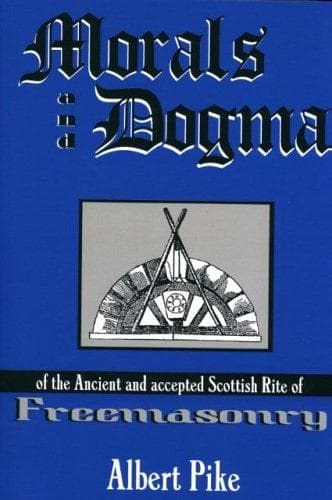
Morals and Dogma of the Ancient and Accepted Scottish Rite of FreemasonryPike, Albert
Religion
Morals and Dogma of the Ancient and Accepted Scottish Rite of Freemasonry
Pike, Albert
Freemasons
And the Mason is familiar with these doctrines of Philo: that the
Supreme Being is a centre of Light whose rays or emanations pervade the
Universe; for that is the Light for which all Masonic journeys are a
search, and of which the sun and moon in our Lodges are only emblems:
that Light and Darkness, chief enemies from the beginning of Time,
dispute with each other the empire of the world; which we symbolize by
the candidate wandering in darkness and being brought to light: that the
world was created, not by the Supreme Being, but by a secondary agent,
who is but His WORD the [Greek: Λογος], and by types which are but his
ideas, aided by an INTELLIGENCE, or WISDOM [Greek: Σοφια], which gives
one of His Attributes; in which we see the occult meaning of the
necessity of recovering "the Word"; and of our two columns of STRENGTH
and WISDOM, which are also the two parallel lines that bound the circle
representing the Universe: that the visible world is the image of the
invisible world; that the essence of the Human Soul is the image of God,
and it existed before the body; that the object of its terrestrial life
is to disengage itself of its body or its sepulchre; and that it will
ascend to the Heavenly regions whenever it shall be purified; in which
we see the meaning, now almost forgotten in our Lodges, of the mode of
preparation of the candidate for apprenticeship, and his tests and
purifications in the first Degree, according to the Ancient and Accepted
Scottish Rite.
Philo incorporated in his eclecticism neither Egyptian nor Oriental
elements. But there were other Jewish Teachers in Alexandria who did
both. The Jews of Egypt were slightly jealous of, and a little hostile
to, those of Palestine, particularly after the erection of the sanctuary
at Leontopolis by the High-Priest Onias; and therefore they admired and
magnified those sages, who, like Jeremiah, had resided in Egypt. "The
wisdom of Solomon" was written at Alexandria, and, in the time of St.
Jerome, was attributed to Philo; but it contains principles at variance
with his. It personifies Wisdom, and draws between its children and the
Profane, the same line of demarcation that Egypt had long before taught
to the Jews. That distinction existed at the beginning of the Mosaic
creed. Moshah himself was an Initiate in the mysteries of Egypt, as he
was compelled to be, as the adopted son of the daughter of Pharaoh,
_Thouoris_, daughter of _Sesostris-Ramses_; who, as her tomb and
monuments show, was, in the right of her infant husband, Regent of Lower
Egypt or the Delta at the time of the Hebrew Prophet's birth, reigning
at Heliopolis. She was also, as the reliefs on her tomb show, a
Priestess of HATHOR and NEITH, the two great primeval goddesses. As her
adopted son, living in her Palace and presence forty years, and during
that time scarcely acquainted with his brethren the Jews, the law of
Egypt compelled his initiation: and we find in many of his enactments
Public-domain text, read in full here on John Shaqi.
Reviews
Reviews
No reviews yet
Be the first to share your thoughts on this work.
Elsewhere in the archive
Join the Discussion
Join the discussion
Sign in to leave a comment or review.
Sign InorCreate an account