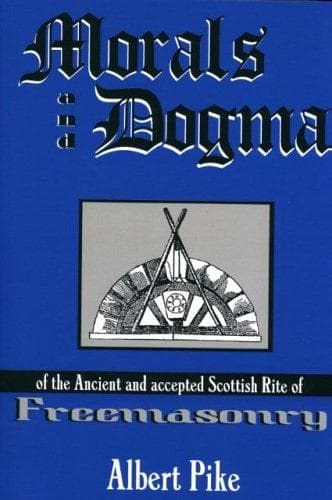
Morals and Dogma of the Ancient and Accepted Scottish Rite of FreemasonryPike, Albert
Religion
Morals and Dogma of the Ancient and Accepted Scottish Rite of Freemasonry
Pike, Albert
Freemasons
The Lion was the symbol of ATHOM-RE, the Great God of Upper Egypt; the
Hawk, of RA or PHRE; the Eagle, of MENDES; the Bull, of APIS; and three
of these are seen under the platform on which our altar stands.
The first HERMES was the INTELLIGENCE or WORD of God. Moved with
compassion for a race living without law, and wishing to teach them
that they sprang from His bosom, and to point out to them the way that
they should go [the books which the first Hermes, the same with Enoch,
had written on the mysteries of divine science, in the sacred
characters, being unknown to those who lived after the flood], God sent
to man OSIRIS and ISIS, accompanied by THOTH, the incarnation or
terrestrial repetition of the first HERMES; who taught men the arts,
science, and the ceremonies of religion; and then ascended to Heaven or
the Moon. OSIRIS was the Principle of Good. TYPHON, like AHRIMAN, was
the principle and source of all that is evil in the moral and physical
order. Like the Satan of Gnosticism, he was confounded with Matter.
From Egypt or Persia the new Platonists borrowed the idea, and the
Gnostics received it from them, that man, in his terrestrial career, is
successively under the influence of the Moon, of Mercury, of Venus, of
the Sun, of Mars, of Jupiter, and of Saturn, until he finally reaches
the Elysian Fields; an idea again symbolized in the Seven Seals.
The Jews of Syria and Judea were the direct precursors of Gnosticism;
and in their doctrines were ample oriental elements. These Jews had had
with the Orient, at two different periods, intimate relations,
familiarizing them with the doctrines of Asia, and especially of Chaldea
and Persia;--their forced residence in Central Asia under the Assyrians
and Persians; and their voluntary dispersion over the whole East, when
subjects of the Seleucidæ and the Romans. Living near two-thirds of a
century, and many of them long afterward, in Mesopotamia, the cradle of
their race; speaking the same language, and their children reared with
those of the Chaldeans, Assyrians, Medes, and Persians, and receiving
from them their names (as the case of Danayal, who was called
Bæltasatsar, proves), they necessarily adopted many of the doctrines of
their conquerors. Their descendants, as Azra and Nahamaiah show us,
hardly desired to leave Persia, when they were allowed to do so. They
had a special jurisdiction, and governors and judges taken from their
own people; many of them held high office, and their children were
educated with those of the highest nobles. Danayal was the friend and
minister of the King, and the Chief of the College of the Magi at
Babylon; if we may believe the book which bears his name, and trust to
the incidents related in its highly figurative and imaginative style.
Mordecai, too, occupied a high station, no less than that of Prime
Minister, and Esther or Astar, his cousin, was the Monarch's wife.
Public-domain text, read in full here on John Shaqi.
Reviews
Reviews
No reviews yet
Be the first to share your thoughts on this work.
Elsewhere in the archive
Join the Discussion
Join the discussion
Sign in to leave a comment or review.
Sign InorCreate an account