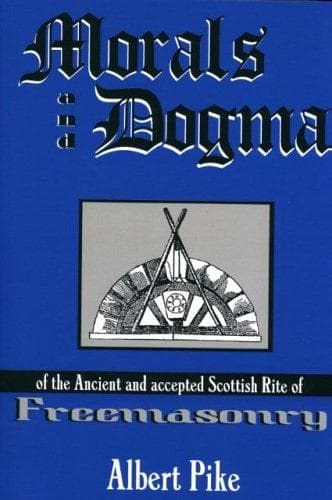
Morals and Dogma of the Ancient and Accepted Scottish Rite of FreemasonryPike, Albert
Religion
Morals and Dogma of the Ancient and Accepted Scottish Rite of Freemasonry
Pike, Albert
Freemasons
Their demeanor was sober and chaste. They submitted to the
superintendence of governors whom they appointed over themselves. The
whole of their time was spent in labor, meditation, and prayer; and they
were most sedulously attentive to every call of justice and humanity,
and every moral duty. They believed in the unity of God. They supposed
the souls of men to have fallen, by a disastrous fate, from the regions
of purity and light, into the bodies which they occupy; during their
continuance in which they considered them confined as in a prison.
Therefore they did not believe in the resurrection of the body; but in
that of the soul only. They believed in a future state of rewards and
punishments; and they disregarded the ceremonies or external forms
enjoined in the law of Moses to be observed in the worship of God;
holding that the words of that lawgiver were to be understood in a
mysterious and recondite sense, and not according to their literal
meaning. They offered no sacrifices, except at home; and by meditation
they endeavored, as far as possible, to isolate the soul from the body,
and carry it back to God.
Eusebius broadly admits "that the ancient Therapeutæ were Christians;
and that their ancient writings were our Gospels and Epistles."
The ESSENES were of the Eclectic Sect of Philosophers, and held PLATO in
the highest esteem; they believed that true philosophy, the greatest and
most salutary gift of God to mortals, was scattered, in various
portions, through all the different Sects; and that it was,
consequently, the duty of every wise man to gather it from the several
quarters where it lay dispersed, and to employ it, thus reunited, in
destroying the dominion of impiety and vice.
The great festivals of the Solstices were observed in a distinguished
manner by the Essenes; as would naturally be supposed, from the fact
that they reverenced the Sun, not as a god, but as a symbol of light and
fire; the fountain of which, the Orientals supposed God to be. They
lived in continence and abstinence, and had establishments similar to
the monasteries of the early Christians.
The writings of the Essenes were full of mysticism, parables, enigmas,
and allegories. They believed in the esoteric and exoteric meanings of
the Scriptures; and, as we have already said, they had a warrant for
that in the Scriptures themselves. They found it in the Old Testament,
as the Gnostics found it in the New. The Christian writers, and even
Christ himself, recognized it as a truth, that all Scripture had an
inner and an outer meaning. Thus we find it said as follows, in one of
the Gospels:
Public-domain text, read in full here on John Shaqi.
Reviews
Reviews
No reviews yet
Be the first to share your thoughts on this work.
Elsewhere in the archive
Join the Discussion
Join the discussion
Sign in to leave a comment or review.
Sign InorCreate an account