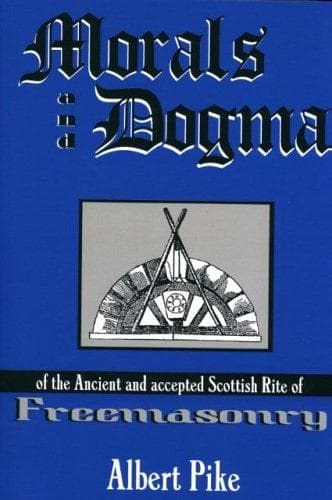
Morals and Dogma of the Ancient and Accepted Scottish Rite of FreemasonryPike, Albert
Religion
Morals and Dogma of the Ancient and Accepted Scottish Rite of Freemasonry
Pike, Albert
Freemasons
To many there were two Principles; the Unknown Father, or Supreme and
Eternal God, living in the centre of the Light, happy in the perfect
purity of His being; the other, eternal Matter, that inert, shapeless,
darksome mass, which they considered as the source of all evils, the
mother and dwelling-place of Satan.
To Philo and the Platonists, there was a Soul of the world, creating
visible things, and active in them, as agent of the Supreme
Intelligence; realizing therein the ideas communicated to Him by that
Intelligence, and which sometimes excel His conceptions, but which He
executes without comprehending them.
The Apocalypse or Revelations, by whomever written, belongs to the
Orient and to extreme antiquity. It reproduces what is far older than
itself. It paints, with the strongest colors that the Oriental genius
ever employed, the closing scenes of the great struggle of Light, and
Truth, and Good, against Darkness, Error, and Evil; personified in that
between the New Religion on one side, and Paganism and Judaism on the
other. It is a particular application of the ancient myth of Ormuzd and
his Genii against Ahriman and his Devs; and it celebrates the final
triumph of Truth against the combined powers of men and demons. The
ideas and imagery are borrowed from every quarter; and allusions are
found in it to the doctrines of all ages. We are continually reminded
of the Zend-Avesta, the Jewish Codes, Philo, and the Gnosis. The Seven
Spirits surrounding the Throne of the Eternal, at the opening of the
Grand Drama, and acting so important a part throughout, everywhere the
first instruments of the Divine Will and Vengeance, are the Seven
Amshaspands of Parsism; as the Twenty-four Ancients, offering to the
Supreme Being the first supplications and the first homage, remind us of
the Mysterious Chiefs of Judaism, foreshadow the Eons of Gnosticism, and
reproduce the twenty-four Good Spirits created by Ormuzd and inclosed in
an egg.
The Christ of the Apocalypse, First-born of Creation and of the
Resurrection, is invested with the characteristics of the Ormuzd and
Sosiosch of the Zend-Avesta, the Ainsoph of the Kabalah and the
Carpistes [Greek: Καρπιστης] of the Gnostics. The idea that the true
Initiates and Faithful become Kings and Priests, is at once Persian,
Jewish, Christian, and Gnostic. And the definition of the Supreme Being,
that He is at once Alpha and Omega, the beginning and the end--He that
was, and is, and is to come, _i.e._, Time illimitable, is Zoroaster's
definition of Zerouane-Akherene.
The depths of Satan which no man can measure; his triumph for a time by
fraud and violence; his being chained by an angel; his reprobation and
his precipitation into a sea of metal; his names of the Serpent and the
Dragon; the whole conflict of the Good Spirits or celestial armies
against the bad; are so many ideas and designations found alike in the
Zend-Avesta, the Kabalah, and the Gnosis.
Public-domain text, read in full here on John Shaqi.
Reviews
Reviews
No reviews yet
Be the first to share your thoughts on this work.
Elsewhere in the archive
Join the Discussion
Join the discussion
Sign in to leave a comment or review.
Sign InorCreate an account