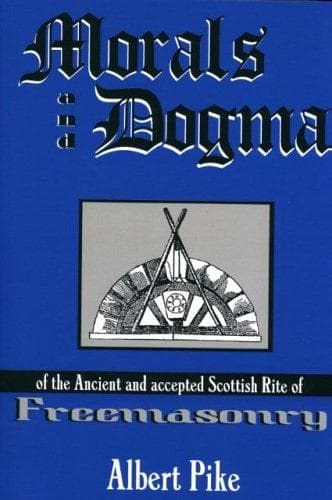
Morals and Dogma of the Ancient and Accepted Scottish Rite of FreemasonryPike, Albert
Religion
Morals and Dogma of the Ancient and Accepted Scottish Rite of Freemasonry
Pike, Albert
Freemasons
There is no human soul that is not sad at times. There is no thoughtful
soul that does not at times despair. There is perhaps none, of all that
think at all of anything beyond the needs and interests of the body,
that is not at times startled and terrified by the awful questions
which, feeling as though it were a guilty thing for doing so, it
whispers to itself in its inmost depths. Some Demon seems to torture it
with doubts, and to crush it with despair, asking whether, after all, it
is certain that its convictions are true and its faith well founded:
whether it is indeed sure that a God of Infinite Love and Beneficence
rules the Universe, or only some great remorseless Fate and iron
Necessity, hid in impenetrable gloom, and to which men and their
sufferings and sorrows, their hopes and joys, their ambitions and deeds,
are of no more interest or importance than the motes that dance in the
sunshine; or a Being that amuses Himself with the incredible vanity and
folly, the writhings and contortions of the insignificant insects that
compose Humanity, and idly imagine that they resemble the Omnipotent.
"What are we," the Tempter asks, "but puppets in a show-box? O
Omnipotent destiny, pull our strings gently! Dance us mercifully off our
miserable little stage!"
"Is it not," the Demon whispers, "merely the inordinate vanity of man
that causes him now to pretend to himself that he is like unto God in
intellect, sympathies and passions, as it was that which, at the
beginning, made him believe that he was, in his bodily shape and organs,
the very image of the Deity? Is not his God merely his own shadow,
projected in gigantic outlines upon the clouds? Does he not create for
himself a God out of himself, by merely adding indefinite extension to
his own faculties, powers, and passions?"
"Who," the Voice that will not be always silent whispers, "has ever
thoroughly satisfied himself with his own arguments in respect to his
own nature? Who ever demonstrated to himself, with a conclusiveness that
elevated the belief to certainty, that he was an immortal spirit,
dwelling only temporarily in the house and envelope of the body, and to
live on forever after that shall have decayed? Who ever has demonstrated
or ever can demonstrate that the intellect of Man differs from that of
the wiser animals, otherwise than in degree? Who has ever done more than
to utter nonsense and incoherencies in regard to the difference between
the instincts of the dog and the reason of Man? The horse, the dog, the
elephant, are as conscious of their identity as we are. They think,
dream, remember, argue with themselves, devise, plan, and _reason_. What
is the intellect and intelligence of the man but the intellect of the
animal in a higher degree or larger quantity?" In the _real_ explanation
of a single thought of a dog, all metaphysics will be condensed.
Public-domain text, read in full here on John Shaqi.
Reviews
Reviews
No reviews yet
Be the first to share your thoughts on this work.
Elsewhere in the archive
Join the Discussion
Join the discussion
Sign in to leave a comment or review.
Sign InorCreate an account